The driving license trial test in Nepal is the final part of the whole licensing procedure. This test will measure your practical skill in driving such as controlling your vehicle, maintaining a balance, performing parking activities, and comprehending road safety guidelines. In the driving license trial test in Nepal, you are assessed with different tasks such as figure 8, slope handling, U-turns, and parking, depending on which you are applying for, either two-wheelers or four-wheelers. To pass these tasks, you should be calm, have control on the clutch, drive with slow speed, maintain mirror awareness, and mastery in figure 8 and ramp.
In this blog, we provide information regarding what to expect on the driving license trial test in Nepal, what score do you need to score to pass the driving test, and where the points can be deducted. Along with this, we also give insights about how to pass the driving license trial test in Nepal, common reasons that candidates fail in the trial and why you should join the driving school.
What to expect on the Driving License Test in Nepal?
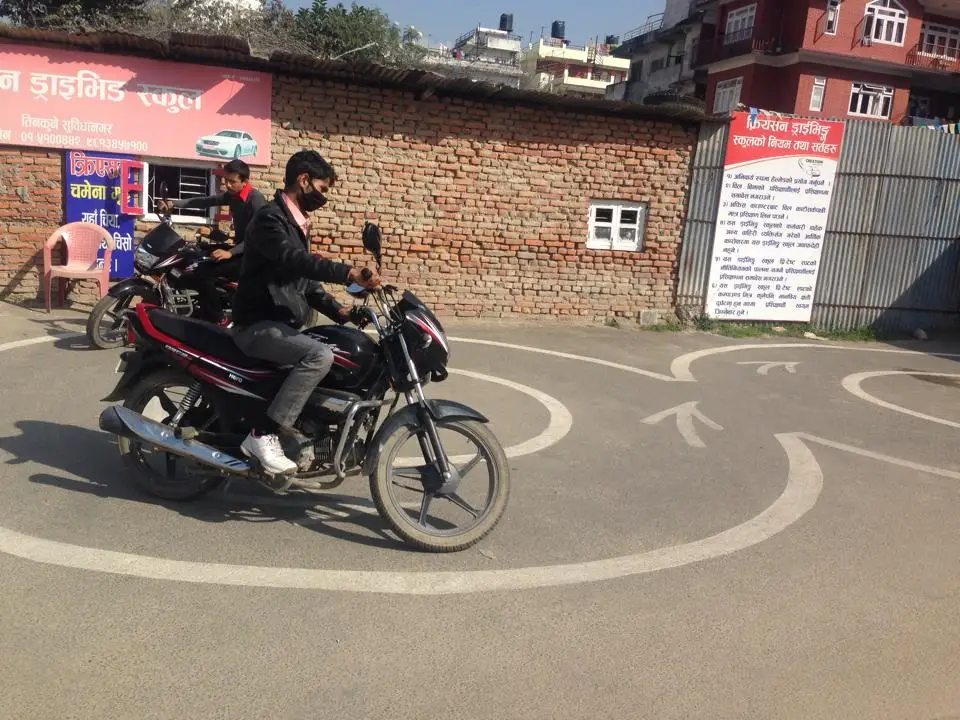
Before you begin your driving trial (Practical exam), you need to present the examiner with all of the required documents and pass the written driving test. There are various things you can expect on the driving license trail test in Nepal. These things include various driving tasks and evaluations that check your balance, control, and knowledge of road rules. Therefore, being aware of what to expect makes it easier to prepare yourself and pass the trials test for obtaining the driving license the first time. In this section, we will explain what to expect for both two-wheelers and four-wheelers.
Two-wheelers
- Figure 8: It is the first phase of the trial. In this section, you should drive your two-wheeler vehicle within the shape of the letter ‘8’. This checks your balance, coordination skills, steering control and balance while driving.
- Narrow plank: It is a thin and narrow plank that you need to drive. This checks the balance and skills required while driving in a straight line without any diversion.
- U-turn: When you are at the point of the U-turn, you have to switch on the indicator before turning without hitting the boundary. The U-turn is needed to assess your ability to turn safely without losing balance or control.
- Traffic lights/signals: The standard traffic lights are used during the trial. They are kept to check whether you understand and follow traffic rules correctly or not.
- Speed breaker: On a trail location, you can find a speed breaker section. It is kept to test your ability to reduce speed and maintain control while passing uneven road surfaces.
- Ramp/slope: It is an inclined surface which comes before completing the trail. It checks your control skills as you start, stop and hold the bike at an incline without rolling backwards.
- Behavioral check: While performing the trial, the instructor observes your behavior. It is necessary for instructors to check your behavior regarding safety measures, indicator usage, and other good driving practices.
For four-wheelers
- Figure 8: The four-wheeler vehicle you drive must go within the figure 8 without touching any boundary lines. This section checks your steering control skills and making correct turns, especially tight turns.
- Speed breaker: It is a raised section on the track. This section checks your ability to reduce speed and maintain smooth control of the vehicle over bumps.
- U-turn: On a trail location, you find a U-turn section where you need to turn your four-wheeler vehicle within a limited space. It is required to test your turning skills, spatial abilities and your safety practices while operating the vehicle.
- Traffic lights: At one of the sections, standard traffic lights are kept in the test. This checks your understanding of road rules and ability to follow instructions correctly.
- Ramp/slope: It is an inclined surface where the instructor tests your control of the vehicle when starting, stopping, or braking on an incline without moving forwards or stalling.
- L-back (Reverse parking): It is considered as one of the hardest sections in the trail. This is a parking task where you need to reverse into an L-shaped space without touching any traffic cones. It tests your reverse driving skills as well as the proper use of a mirror for accurate parking.
- Behavioral check: The instructor observes your behavioral traits in such a test. The skills to drive safely, following traffic rules and using signals and showing good discipline is mainly observed.
How much do I need to score to pass the driving license trail test in Nepal?
In early 2023, the government of Nepal introduced a point-based evaluation system through which the candidates were able to pass the practical exam (trial) more easily. Under this evaluation system, you should score at least 70 points out of 100 points to pass the driving license trail test in Nepal. In the trial exam, the examiner checks different driving tasks such as balance, vehicle control, turning, parking, slope handling, and adherence to traffic rules. Each of the tasks carries certain marks. If you make any mistakes, some points will be deducted, which reduces the chances of passing the driving license trail test. As per the current marking system, you can make minor mistakes but still pass the trial, making this process more flexible than the previous pass-or-fail-only system. However, making serious mistakes such as boundary line touching and losing control of the vehicle can lead to failure in the trial.
Where can points be deducted in the driving license trial test in Nepal?
As mentioned previously, the government introduced the point-based system in early 2023, and the candidates must bring 70 points out of 100 to pass the driving license trial test in Nepal. Therefore, many of you may not know where the points can be deducted while performing the trial. Losing the points consistently means there are higher possibilities of failing the trial test. Some of the sections where points can be deducted for both two-wheeler and four-wheeler are listed in a table format.
| Section | Max points | Points Deduction | Two-wheeler | Four-wheeler |
| Figure 8 | 20 | 5 – 10 points | 5 points deducted for touching the boundary line once, and 5 points minus if you touch your feet to the ground once. | 5 points will be deducted each time you touch the boundary line, up to two times. |
| Narrow plank | 10 | Directly fail | Directly fail if your feet touch the ground and are unable to cross the plank. | Not applicable |
| U-turn | 10 | 10 points | Loses 10 points if you forget to turn on the indicator. | Deduction of 10 points if you failed to activate the indicator. |
| Traffic lights/signals | 15 | 15 points | Cut 15 marks if you fail to follow the traffic lights that are hanging. | Lose 15 marks for not following traffic lights. |
| Speed breaker | 15 score for two-wheelers and 10 points for four-wheelers | 10 points for two-wheeler and 5 points for four-wheeler | 5 points reduction for touching the ground with your feet and 5 points cut if your two-wheeler engine turns off. | Deduction of 5 points if your vehicle’s engine shuts off. |
| Ramp/slope | 20 | Directly fail | Instantly fail if you cross the boundary, engine turns off more than once and your vehicle slips more than 6 inches. | Fail immediately if you breach the boundary, engine shuts off more than once, and your vehicle shifts more than 6 inches. |
| Parking (L-back) | 15 | 10 points | Not applicable | The points will be deducted if your vehicle touches the boundary. |
| Behavior / Safety Check | 10 | 3 to 4 | 3 points cut if you didn’t check the brake, tyre and mirror, 4 score minus if you didn’t lock the helmet and 3 points reduction of you perform rough driving | Deduction of 4 points if you didn’t wear a seatbelt, 3 points cut if you didn’t check the mirrors, tyres and brakes and reduction of 3 points if you perform reckless driving throughout the trail. |
How to pass the Driving License Trial Test in Nepal with 100% score?
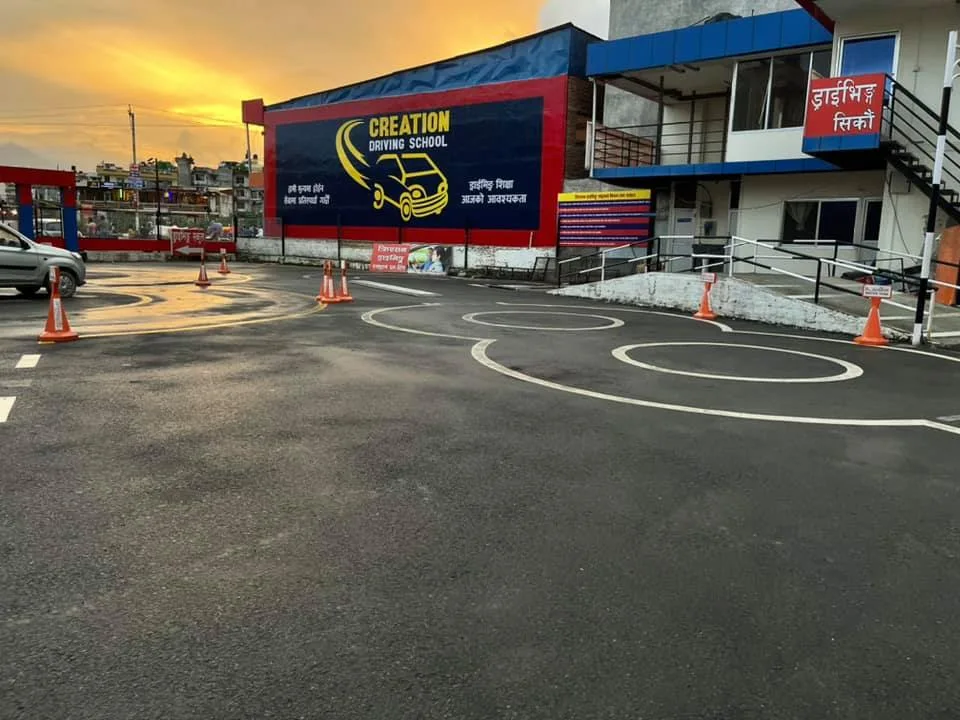
Passing the driving license trial test in Nepal with a 100% score is difficult, but it can be achieved. By performing all tasks perfectly without making any mistakes or losing any points during the entire test, you can secure a full score. To avoid mistakes that can lead to losing points or failing the trial, there are different rules and instructions that you must follow. Some important tips to pass both the two-wheeler and four-wheeler driving license trial tests in Nepal are mentioned below:
For two-wheeler
- Figure 8: Mastering the figure 8 leads to higher chances of passing the driving license trail test in Nepal. You should use a half clutch, keep the speed slow and maintain proper balance throughout the turn.
- Narrow plank: In the narrow plank section, you need to drive straight. In order to pass this section, you need to fix your eyes on the endpoint. Moreover, you shouldn’t look down at the wheel as it can cause loss of balance and increase the chances of failing the test.
- U-turn: To turn your vehicle in the U-turn section, you should keep your vehicle speed low, turn on the indicator and steer smoothly while maintaining proper control of the vehicle.
- Traffic lights: Traffic lights are also one of the important sections of the trial. Before crossing the traffic light section, you need to see the colour that is shown in the traffic lights. If the light turns red, you need to stop for a while until it turns green. When the light is green, you can easily go, and if the light is yellow, you should slow down and prepare to stop.
- Slope: It is one of the difficult sections of the trail. To pass the slope, you should slow your vehicle speed, control your clutch properly, press the brake and release it when the instructor tells you to move.
By controlling the clutch smoothly, maintaining steady eyes and having zero panic movements, you can successfully pass the driving license trial test in Nepal.
For four-wheeler
- L-back (Parking): It is considered one of the hardest sections in the entire trail of four-wheelers. Mastering it can help to increase the chances of passing the driving license trail test in Nepal. You should move slowly in one gear, use clutch control for smooth entry, adjust steering in small movements and always align mirrors before entering is the key to completing the L-back section.
- Ramp / Hill Start: This section is the hardest part of the trail. To complete this section, you must stop fully in line for a few seconds, hold the clutch at the bite point, add gentle accelerator for power, and release the clutch slowly when you move forward.
- U-turn: In the U-turn section, you need to slow down the speed of your vehicle, check mirrors, use indicators, turn wide and smooth and shouldn’t rush to rotate the steering to successfully complete this part.
- Traffic Signals: You should obey the traffic signals to avoid losing the 15 points. You should stay alert, stop when traffic lights turn red and yellow and move when the lights turn green.
- Figure 8: To successfully complete the figure 8 in four-wheeler vehicles such as cars, you should precisely control the steering, drive slowly and maintain proper clutch control throughout the section.
With the combination of clutch control, mirror discipline and slow precision driving, you can easily pass the driving license trial test in Nepal.
Common Reasons Candidates Fail the Trial
Many candidates fail the driving license trial test in Nepal, not because they lack driving skills, but because they feel overconfident/underconfident or make small mistakes that lead to failure. If you feel the same way, you should stay calm, practice regularly, and remain fully focused during the trial test. There are many other common reasons why the candidates fail the driving trial. Some of them include:
- Losing balance during the Figure 8 or narrow plank section.
- Putting a foot down frequently during the bike trial.
- Touching or crossing boundary lines and cones.
- Poor clutch control.
- Rolling backward on the ramp or slope section.
- Forgetting to use indicators before turning.
- Using the high gear during the trial.
- Looking down instead of looking ahead while riding.
- Losing control during U-turns.
- Lack of confidence and nervousness.
If you need further information regarding common mistakes that candidates often make that lead to failure, do check out the smart tips to crack your Nepal Driving License Test on the first try blog.
Should You Join a Driving School?
Passing the driving license trial test in Nepal requires joining a reliable and reputable driving school. Joining the trusted driving center helps you learn proper driving skills, understand traffic rules, and improve your chances of passing the trial test successfully. Among many driving centers, one of the best driving schools in Kathmandu is Creation Driving School. Some of the reasons why you should select the Creation Driving School are listed below:
- Professional training: Our experienced instructor offers proper guidance regarding correct driving techniques, road safety and vehicle control.
- Confidence building: We attempt to increase your level of confidence through repeated practice and proper guidance.
- Secure and welcoming learning environment: We provide you with a safe and welcoming environment which will make it easy for you to learn.
- Higher success rate: Most of the students who have taken driving training from us have successfully passed the driving license trial test with 100% score.
- Individual attention: Our instructor provides full attention to every individual who is taking the training from us, from the beginning to the end.
Conclusion
The driving license trial test in Nepal may be challenging, but with the help of proper preparation, practice and choosing a reliable driving center, it can make it easier to pass. In order to pass the driving license trial test in Nepal, having driving skills is not enough; you should have discipline, patience, and careful attention to every detail of the trial.In addition to that, understanding the test structure, practicing difficult trial sections, and avoiding small mistakes like poor balance are also important. It is also equally crucial that staying calm and reducing nervousness during the test can greatly improve your performance and increase your chances of passing the driving test.
In this blog, we have provided information regarding what to expect on the driving license trial test in Nepal, how much score do you need to score to pass the driving test, and where the points can be deducted. Along with this, we have also given insights about how to pass the driving license trial test in Nepal, common reasons that candidates fail in the trial and why you should join the driving school. For further information regarding driving license trial tests in Nepal, check out some other blogs. If you are seeking a professional driving school in Kathmandu, contact Creation Driving School – one of the best driving centers in Kathmandu.
FAQs on Driving License Trial Test in Nepal
If the trial examination is unsuccessful, when and how many times can candidates retake the exam?
If you are unable to pass your driving license trial test in Nepal on your first attempt, you can retake the exam up to two times. The trial must be done within the 90-day period from the date of your first failed attempt.
What is the hardest section of the Nepal driving trial?
The hardest section of the driving license trial test in Nepal is the ramp (uphill and downhill) for both two-wheelers and four-wheelers.It carries 20 points, and if you halt on the incorrect line or move backward, it can result in immediate disqualification.
What is the cost to take the trial test and pay the license fee?
The cost to take a trial test is Rs 500 per attempt. Once you pass the trial successfully, the official license charge (revenue/rajaswa) is Rs. 1,500 for scooters/motorcycles and Rs. 2,000 for cars/jeeps.