Obtaining a driving license in Nepal is one of the necessary things in order to drive legally and safely on the road. However, many candidates find it difficult to clear both written (Likhit) and practical exams (trial) due to a lack of proper preparation and understanding of traffic rules. These exams are taken to check both your theoretical knowledge of road signs, traffic regulations, and your practical ability to handle a vehicle safely in real conditions. Many candidates fail to pass these exams because they underestimate its requirements or do not practice enough. Therefore, giving the mock test regularly, arriving at the center early, mastering the figure “8”, and staying calm can help you crack the Nepal driving license test on the first attempt successfully.
In this blog, we provide information regarding categories of driving licenses, eligibility, and documentation preparation for acquiring a Nepal driving license test, and tips to crack the written exam (Likhit). Along with this, we also give insights about tips to crack the practical test and common mistakes to avoid to pass the Nepal driving license test on the first try.
Categories of Driving Licenses in Nepal
In Nepal, the driving licenses are divided into several categories depending on the type and size of vehicle you drive. Whether it is a two-wheeler or 4 wheeler, each category requires a specific license type based on the engine size and vehicle class. These license categories can only be collected from the Transport Management Office (Yatayat Karyalaya) once you pass the practical test (trial). Below are the categories of driving licenses available in Nepal.
- Category A: This Category is for motorcycles, scooters, and mopeds.
- Category B: This category includes cars, vans, jeeps, and delivery vehicles up to 3,500kg.
- Category K: This category applies to specific electric scooters, and low-powered mopeds.
- Category C: Category C is for light trucks, tempos, and minibuses.
- Category D: This category applies to heavy trucks and buses.
- Category E: This category is for heavy equipment, and special vehicles such as cranes, road rollers and loaders.
- Category H: This category applies to agricultural vehicles and tractors.
Do note: For acquiring these licenses, your age must be at least 16 for two-wheelers, 18 for light four-wheelers, and 21 for medium/heavy vehicles.
Eligibility and Documentation Preparation for acquiring Nepal Driving License Test
To pass the Nepal driving license test, you should have mandatory documents and be eligible for the specific vehicle category. The question may arise, “What must be the eligible criteria and what documents are required for passing the Nepal driving license test?” Well, the eligible criteria and mandatory documents required are mentioned below:
Eligible criteria
- The candidate’s age should be at least 16 years old for scooters/motorcycles, 18 for jeeps/cars, and 21 for heavy vehicles.
- He/she must be a Nepali citizen.
- The candidate should successfully complete physical and medical tests to confirm he/she has adequate vision, hearing, and no disqualifying physical or psychological conditions.
Required Documents
- Download and print out your online application form produced from the official DoTM Online Portal.
- An original Nepali citizenship certificate and a photocopy of it (both sides).
- A blood group card that states your blood group from a valid medical institution or certified health professional.
- Two to three current passport-sized photos.
- A sum of Rs. 10 post stamps to attach to your printed application form.
- A printed vision certificate/eye test (for Category B and higher) and the original past driving license for adding a new vehicle category.
Tips to crack the Written Exam (Theory Test) – In points
For the written exam (Likhit), you first need to apply for the driving license online through the DoTM portal, fulfilling age and health requirements. After that, you need to submit the necessary documents (citizenship certificate, application form, and blood group card) to the specific Transport Management Office (Yatayat Byabastha Karyalaya) for the biometrics. Once you complete these steps, you are allowed to perform a written exam (Likhit). There are various tips you can follow to crack the driving license written exam. Some of the effective tips are listed below:
- Understand the exam format: Before giving a driving license exam, it is essential to understand the exam format. The exam contains 25 multiple-choice questions, each of the question carries 4 marks. To pass the written exam, you should get 60 marks (15 correct answers). The time limit for the theory exam is 30 minutes. You can take the exam in either English or Nepali.
- Focus on traffic signs: Traffic signs are one of the easiest ways to score marks. You should focus on warning signs, mandatory signs, and guide signs properly to score the marks. It is essential to spend at least 15 minutes regularly to remember these signs.
- Give mock tests regularly: Giving mock tests helps quite a lot to secure good marks in written exams. A mock test helps you to identify your weak areas, improve time management, build confidence, and get familiar with the exam pattern. Mock tests provide practice with all possible types of questions that may come in the written exam (Likhit).
- Arrive Early at the center: It is advisable to come early at the center so that you remain calm and avoid any kind of last minute pressure. You should be at the center at least 30 minutes prior to the exam so that you can comfortably sit and answer all the questions accurately.
- Read the questions and options carefully: After getting the questions, you need to carefully read each and every question as well as options, as many questions are tricky and have similar options. You need to be attentive to each word so that you can understand the question and choose the appropriate answer.
Tips to crack the Practical Test (Trial)
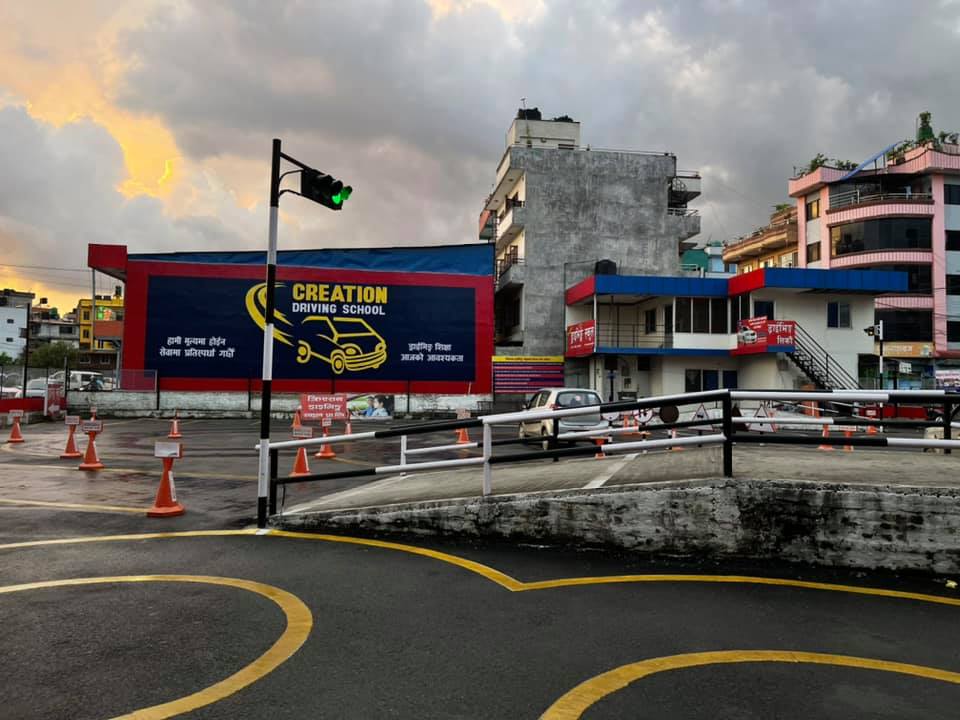
After passing the written exam, you are eligible to perform the practical test (trial). To crack the Nepal driving license test, you need to achieve at least 70 out of 100 points according to the existing point-based system. This test is designed to know your real driving ability, road safety awareness, and control over the vehicle in different situations. Some of the tips to crack the practical test (trial) are mentioned below:
For two-wheelers
- Master the figure (8): You need to practice driving the bike or scooter smoothly in an “8” track without touching your feet to the ground. It is important to maintain balance and control during the process of taking turns and driving through the “8” track.
- Traffic Lights and Indicators: During the trial, it is necessary to make sure that you use indicators during turning and drive according to traffic lights. Many candidates lose marks due to forgetting to use indicators while turning and not following traffic lights properly.
- Maintain Slow Speed: Throughout the trail, you need to slow the speed as much as possible. Riding the bike fast can reduce balance and increase mistakes during turns and narrow paths, resulting in failure.
- Stay Calm: You need to stay calm while performing a trial. A panic and nervousness often lead to bigger errors. Staying relaxed and focusing on control can help to pass the test.
- Manage Your Stability: Managing stability during the trial helps to pass the trial and achieve a license. You must learn how to apply brakes without making any sudden movements, which helps you maintain your stability.
You should also practice with various bikes, such as Hero Splendor, Yamaha Saluto, and Honda Pleasure (old as well as new ones), as these types of bikes are used to perform trail rides at the designated Transport Management Office.
For Four-Wheelers
- Master the L-back: The L-back is considered one of the hardest parts of the trail. You need to practice reverse regularly with proper steering control and mirror observation. Following these tips to reverse the car without touching poles can lead to passing the trial.
- Uphill Control: Uphill control is also one of the difficult parts of the trail. It is essential to learn proper clutch, break and accelerator coordination while driving uphill. In addition, you should also prevent vehicles from rolling backward while stopping at an uphill slope.
- Follow rules: While giving a trial, it is essential to follow the rules accurately. You need to wear your seatbelt, adjust the mirror, and follow all the trail instructions carefully. Moreover, you also need to use indicators while turning.
- Clutch control: Smooth clutch control is essential in the trail. It is essential to avoid releasing the clutch quickly; it may stall the engine. You need to practice maintaining the balance between the clutch and accelerator.
- Turning technique: In the trail, you find a section where you need to turn the 4-wheeler vehicle. You need to turn slowly and confidently. In addition, you need to use proper steering and lane positioning while turning. You shouldn’t cut corners too sharply or with excessive speed.
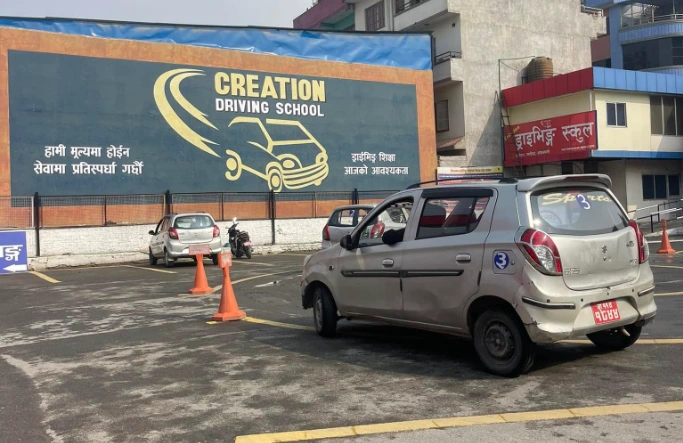
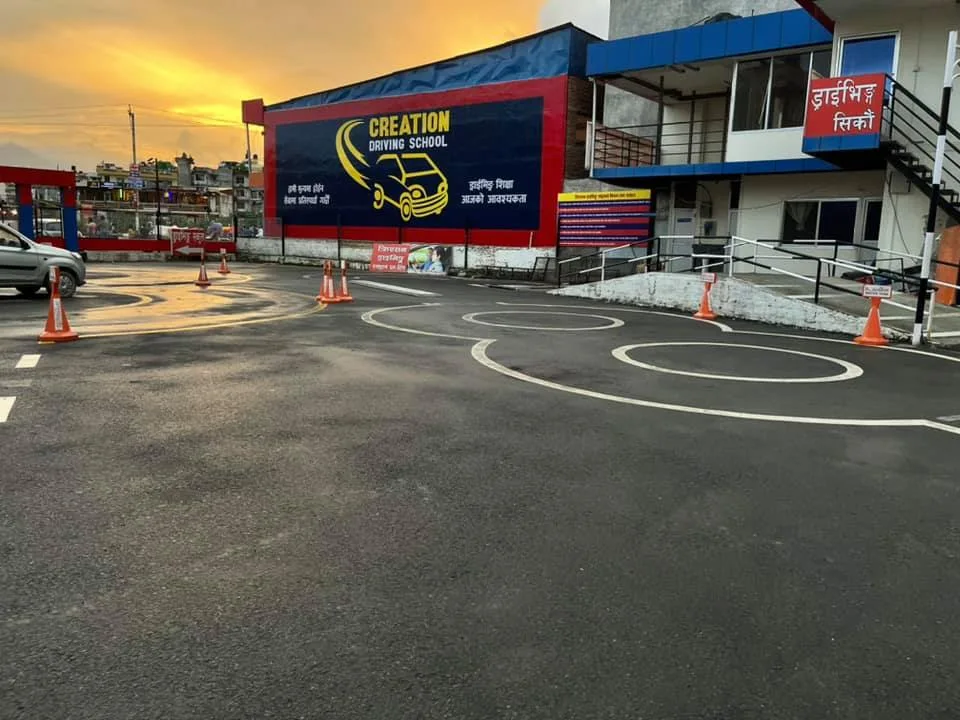
If you want to learn to drive and are seeking to pass the Nepal Driving license test, the best place you can find to practice is Creation Driving, located at Madhyapur Thimi. This driving school, one of the best driving centers in Kathmandu, helps you to improve your driving skills through professional guidance, regular practice sessions, and trial-based training.
Common Mistakes to Avoid to Pass the Nepal Driving License Test on the First Try
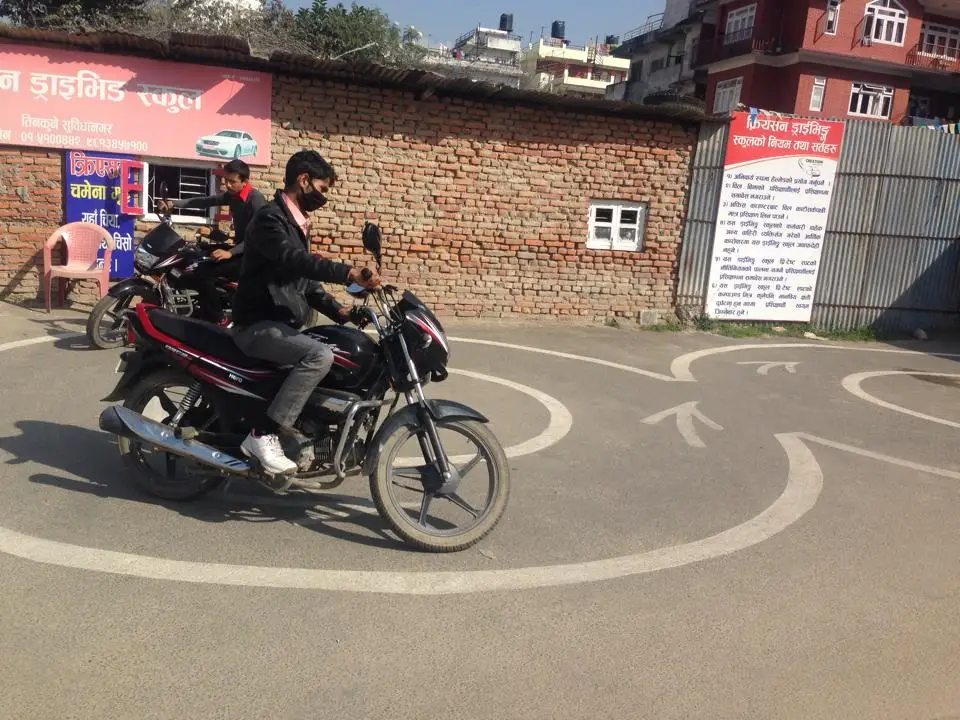
There are several common mistakes that many candidates make while attempting the test. Such mistakes may seem minor, but they will cause you to lose marks or even fail the practical test. Therefore, it is important to be careful and avoid them during the trial. Some of the common mistakes that should be avoided to pass the Nepal Driving license test are listed below:
- Arriving at the exam center without proper preparation.
- Ignoring traffic signs and basic road rules during study sessions.
- Fast driving of the vehicle in the practical test.
- Feeling overconfident while conducting the trial.
- Taking risky steps during the trial.
- Feeling nervous during the whole trial period.
- Not following the instructions properly.
Conclusion
You can crack the Nepal driving license test in your first attempt by concentrating completely on preparing yourself and following a systematic approach. Knowing the traffic rules, learning about the road signs, and doing practice sessions for both Likhit and Trail will definitely increase your chances of success. Apart from that, avoiding mistakes like nervousness, lack of control over the vehicle, and failing to obey instructions will make sure that you crack the Nepal driving license test in your very first attempt. With patience, confidence, and proper preparation, you can crack both the written and trial tests easily and start your journey of driving in Nepal.
In this blog, we have provided the information regarding categories of driving license, eligibility, and documentation preparation for acquiring a Nepal driving license test, and tips to crack the written exam (Likhit). Along with this, we also provided insights about tips to crack the practical test and common mistakes to avoid to pass the Nepal driving license test on the first try. If you are seeking an ideal driving center in Kathmandu, contact Creation Driving – one of the best driving schools in Kathmandu.
FAQs on Nepal driving license test
1. What is the age limit required to get a driving license?
As per Section 51 (a, b, c) of the Provincial Transport and Traffic Management Act, 2075, the age limit for a candidate to obtain a driving license is:
1. For heavy vehicles: You must reach an age of 21 years.
2. For medium and small vehicles: Candidates must be 18 years or above.
3. For cars, jeeps, and two axled vehicles: You should be at least 16 years old.
2. Who is disqualified from receiving a driver’s license due to health reasons?
The candidates who are disqualified from receiving a driver’s license due to health reasons are listed below:
1. If a candidate is unable to drive because of physical or mental disabilities.
2. Those with poor eyesight, even when wearing glasses.
3. If a candidate suffers from color blindness, it makes it hard to tell red, green, and yellow apart.
4. Those who cannot perceive normal sound, signals and voices.
5. If a candidate has had their driving license revoked in accordance with Section 65.
3. What questions are asked in the driving license test in Nepal?
In the Nepal driving license test, there are various questions that are asked to the candidates. Some of the questions are listed below:
1. Traffic Signs and Signals
2. Driving Knowledge and Safe Driving Practices
3. Vehicular Act and Regulation
4. Technical and Mechanical Knowledge
5. Accident Awareness
4. Can I take the theory test and practical test again after failing once?
Yes, you can definitely retake theory as well as practical tests. However, the rules will be different, depending on the specific test you did not pass and how many times you have attempted it. If you failed the written exam, you need to complete the form again, pay the fees, and take the test again. For the practical test, you are allowed to give the trial 3 times (2 retries) within a 90-day period.