+977-9849213390, 9849449110, 9813457100 Sunday-Saturday: 6:00 AM - 18:00 PM

Driving License Process 2026: Online Form, Trial & Fees

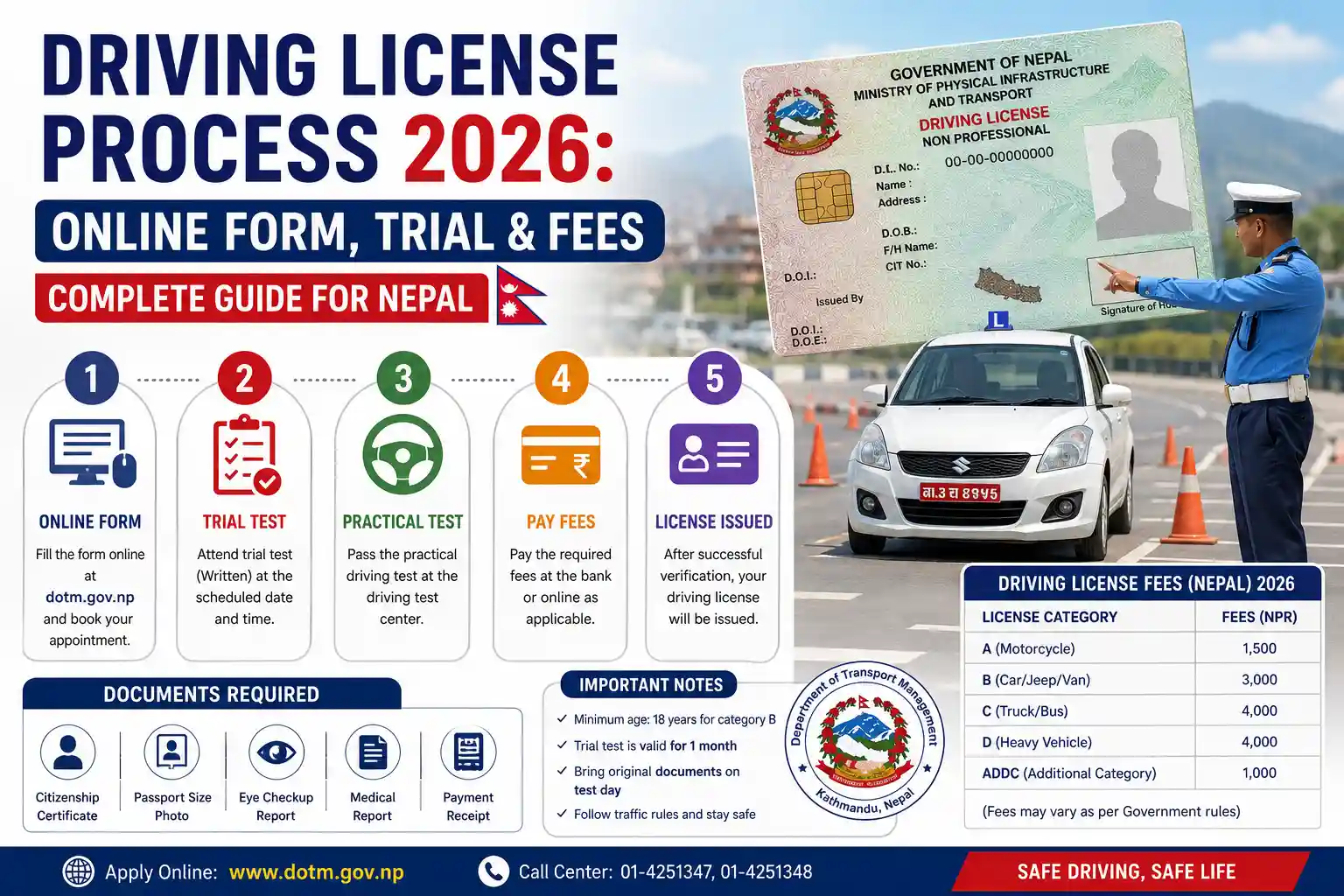
The driving license process in 2026 has become more organized and technology-driven, helping you to perform most steps online. You can fill out the online form, select their preferred category, office, and appointment date, and proceed through the required stages of verification, written examination, and trial test. In the written test process, you need to follow all the steps serially (verifying documents to finish the test). Moreover, you also need to follow all the procedures for the driving license test, ranging from verifying the documents to completing the trial test. In this entire stage, you need to pay some amount of money (2,650 and other hidden costs for a bike/scooter and 3,150 for a car/jeep). 

In this blog, we provide information regarding categories of driving licenses, eligibility requirements, documents required, and a stepwise process for the online driving license form. Along with it, we also give insights about the written examination process, driving trial test process and driving license fee structure. 

Categories of Driving License in Nepal
Categories of Driving License in Nepal

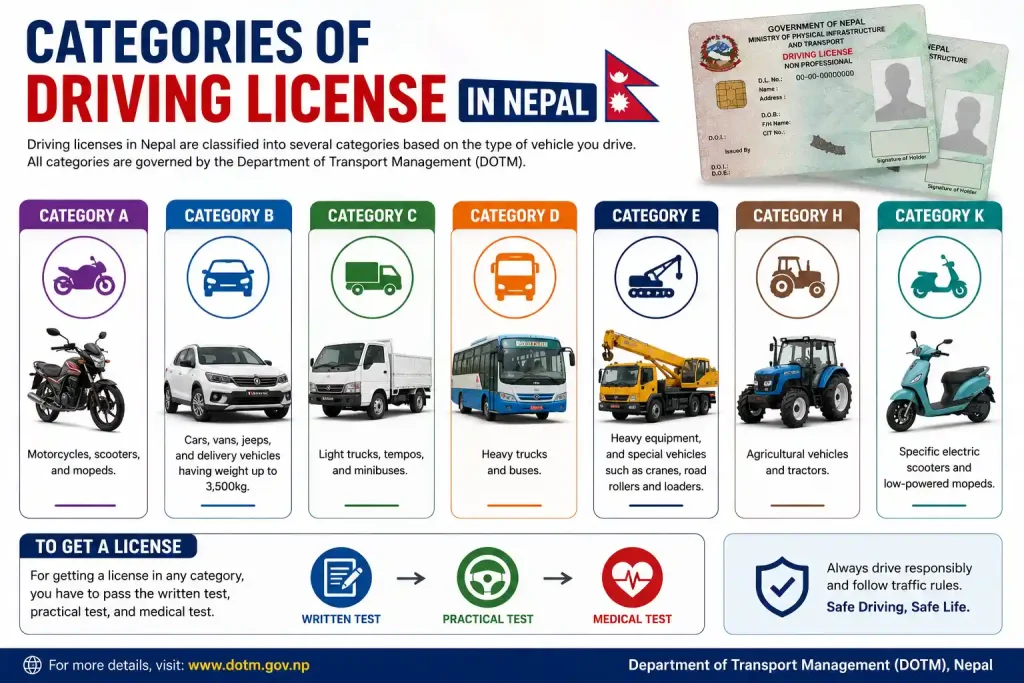
Driving licenses are classified into several categories in Nepal based on the type of vehicle you drive. All the categories are governed by the Department of Transport Management (DOTM). Each of the categories have particular kinds of vehicles like motorbikes, cars, light vehicles, heavy trucks, and public transports. For getting a license of your categories, you have to pass the written, practical, and medical test. The categories of driving licenses in Nepal are listed below: 

  • Category A: Motorcycles, scooters, and mopeds.
  • Category B: Cars, vans, jeeps, and delivery vehicles having weight up to 3,500kg.
  • Category C: Light trucks, tempos, and minibuses. 
  • Category D: Heavy trucks and buses. 
  • Category E: Heavy equipment, and special vehicles such as cranes, road rollers and loaders.
  • Category H: Agricultural vehicles and tractors. 
  • Category K: Specific electric scooters and low-powered mopeds.

Eligibility Requirements for a Driving License
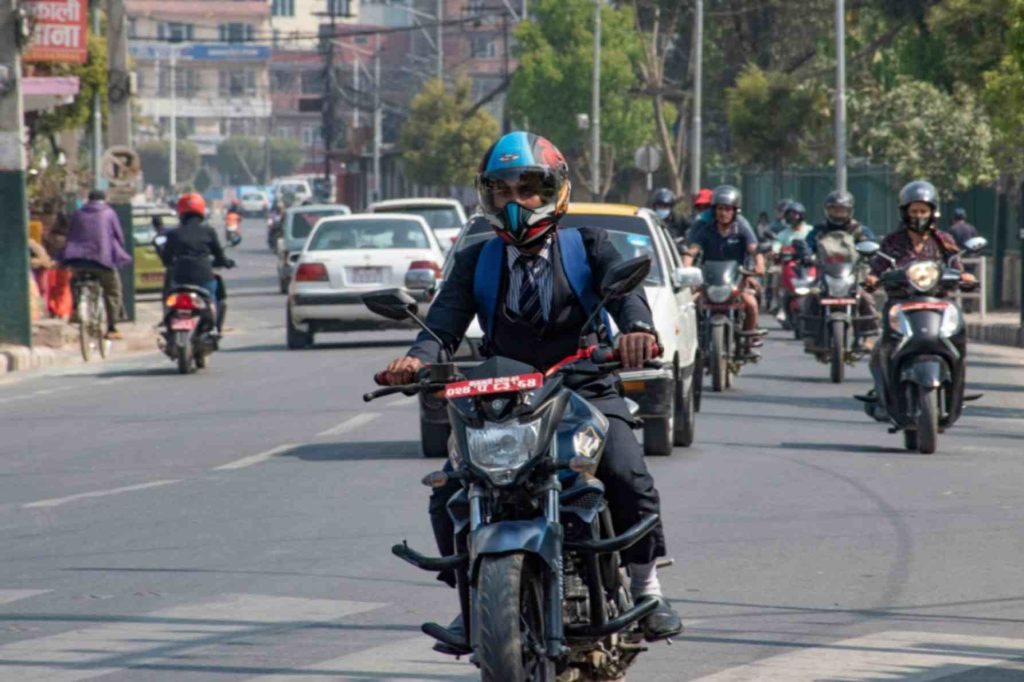
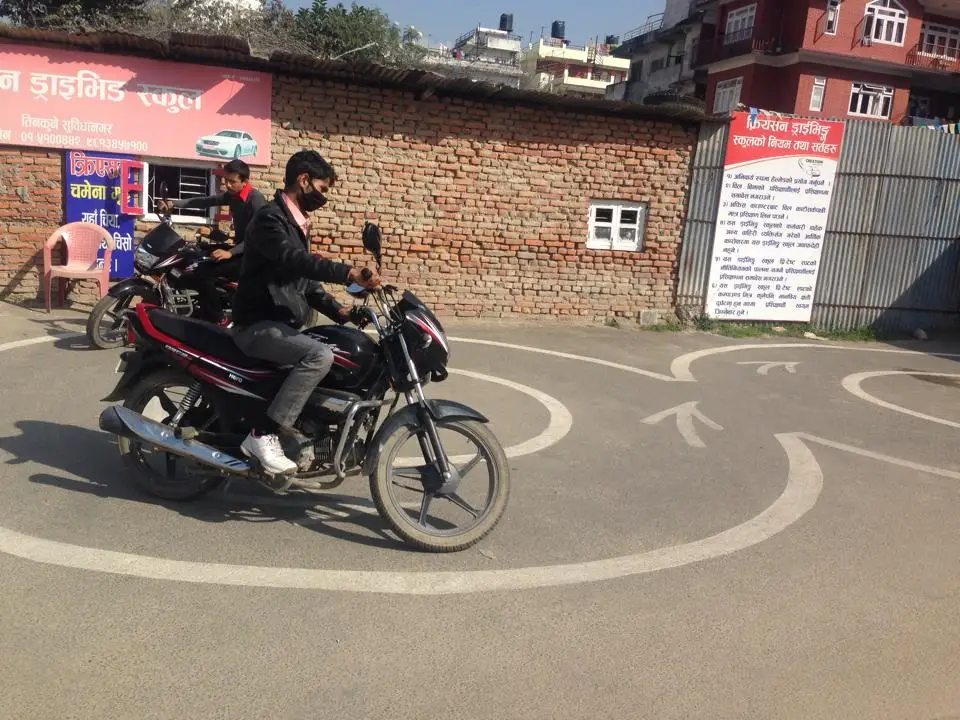
Driving a bike on the main road

For getting the driving license in Nepal, you should be eligible as per the criteria provided by the Department of Transport Management (DoTM). These criteria vary depending on the vehicle category, such as motorcycles, cars, or heavy vehicles. Now, you may have a question regarding, “What are the eligibility requirements for obtaining a driving license for different categories?” Below are the age requirements that are needed for getting a driving license. 

Age Requirements

You must reach a certain age (minimum of 16 to 21 years) as specified by the DOTM to obtain a driving license. The age requirements for obtaining a license are different based on the category of driving license you are taking. Below are the age requirements for obtaining a driving license. 

  • Two-wheelers (Motorcycle and Scooter): A person must be 16 years old to acquire a two-wheeler driving license.
  • Light Vehicles (Cars, Jeeps, Vans): You should be at least 18 years old to get the light vehicle driving license.
  • Heavy/Commercial Vehicles: You should be a minimum of 21 years old to get a driving license for heavy/commercial vehicles (trucks and buses). 

Physical and Medical Fitness

After you verify your document and complete the biometrics, the examiners test your physical and medical fitness. It is done in order to check whether you are capable of performing safe driving or not. Below are some of the eligibility requirements in the context of physical and mental fitness.

  • You shouldn’t have weakened eyesight or color blindness; instead, you should have normal or corrected vision. 
  • Applicants should be able to detect normal sounds, alerts, and vehicle horns.
  • You must not have any physical impairment that affects safe driving.
  • Applicants must reach the minimum age requirements based on their vehicle. 
  • You shouldn’t have any disorders that hinder judgment or rapid decision-making in different road environments.
  • Applicants should not be affected by drugs or alcohol during evaluation.
  • You must be able to understand road signs, signals, and traffic rules easily. 

Documents required for the driving license process 

When applying for a driving license and proceeding to the biometrics stage, certain documents are required. These documents have to be submitted to the DOTM office for verification. Possession of all documents correct helps to prevent any delay during the process. The following is a list of documents for applying for the driving license:

  • Original Nepali citizenship certificate with a copy. 
  • Printed version of the registration form. 
  • A valid blood group card showing blood type from any certified medical institution.
  • At least 2 to 3 recent passport-sized photos. 
  • A Rs. 10 stamp ticket is to be attached to your printed application slip.
  • A certificate of vision and eye test, especially for 4-wheeler vehicles.

Related Blog: How to Prepare for Your Driving Test

Online Driving License Form Nepal – Step-By-Step process

Obtaining a driving license is a must for anyone who wants to drive a vehicle legally in Nepal. It not only helps you enjoy the freedom of movement but also makes travel easier and gives you a sense of independence. To apply for the online driving license form in Nepal, there is a series of processes you need to follow. Following this step-by-step process helps you in completing the application smoothly and correctly. Below are the step-by-step processes you must follow to apply for a driving license. 

Step 1: Open the DoTM portal 

Initially, you need to open Google Chrome on your computer or smartphone. After opening Chrome, you need to type the applydl.dotm.gov.np and click Enter to enter the DoTM applicant login interface. Do note that the appointment slots are limited, so if you didn’t find the slot, login to the next day.

Step 2: Enter Your Mobile Number And CAPTCHA

In the blank space, you need to put your mobile number. After that, enter the same CAPTCHA that is provided in the Enter Captcha field. Then, you get the notification of 6-Digit M-PIN (OTP) on your mobile via SMS in a second.

Step 3: Type the M-PIN

After you receive your M-PIN, you need to type it into the check MPIN in your mobile message bar to proceed to the next step. You need to save this M-PIN as it can be used for future login also. 

Step 4: Select Your License Status

In this step, you get the 3 options. Among these options, you need to choose the one that matches your situation. If you don’t have a driving license, choose the first option. Moreover, if you have a driving license, then select the second option, and if you don’t have a driving license but have completed the biometrics/written exam, you need to choose the last option. 

Step 5: Select your citizenship country

After you select your license status, you are asked which country you are a citizen of. Here, you need to select Nepal and press Next. 

Step 6: Fill Citizenship Details In English

In this step, you need to fill in all the details that are asked for. You fully need to enter the personal information that matches your citizenship certificate. The personal information you need to fill up include the first name, middle name, last name, DOB (Date of Birth), Citizenship number, issued district, issued date and email. If you don’t have a middle name and email address, you can ignore it. After entering all the personal details, you can simply click on the next option.  

Step 7: Fill Applicant Details In Devanagari

Once you fill in your citizenship details and press the next button, the applicant details page opens. There, you need to fill in the details that are asked, such as name, gender, blood group, occupation and education level. The details such as middle name, identity mark and training institution are optional. You need to fill in all the details in the Nepali language. 

Step 8: Guardian And Address Information

After you fill out the questions that are asked, you need to choose your guardian relationship. After that, you need to type your guardian’s full name. Then, type your permanent address that is in the citizenship certificate, and if you have a temporary address, you need to fill it separately in the provided fields. 

Step 9: Upload Citizenship Photos

In this step, you need to upload your citizenship photo (both sides). The photo should be clear and shouldn’t have size more than 1 MB. After that, click next for further process. 

Step 10: Review And Submit

Now, all of the entries are shown on a confirmation page. At this stage, you need to carefully check each and every field to ensure the entries are correct. Once you review the entries, you need to tick the declaration checkbox, click “Next” followed by clicking “ok” to confirm it. Make sure that you have written your Reference Number and have a screenshot of it. After submitting, if you identify any errors, you need to go to the e Transport Office before your appointment date for the correction. 

Step 11: Select Category, Office And Appointment Date

This is a very important step in the application process. Initially, you need to click at the apply for New Licenses, then choose “I want to do a health checkup in the Transport Management Office”. After that, you need to select your vehicle type. At the bottom of the same page, you see the office selection option and the desired date for the office visit. There, you have to select the office and date where you want to take the written exam and trial test. After doing it, click to the next. 

Step 12: Download And Print Your Application

The application slip (registration details) opens. You must download this page and generate the PDF file. This form should be printed on A4 paper. After that, you need to carry this slip along with your original citizenship certificate to the Transport Office on your scheduled appointment date.

Written Examination Process 

Once you follow the steps and complete the biometrics, the next step before performing a trial exam is giving the written (Likhit) test. It is an important step that determines whether you are capable of taking the trial exam and whether you understand the rules and regulations. Below is the process you should follow to give the written exam at the DoTM. 

  • Step 1: Ensure that you bring your original citizenship certificate, printed admit card, fee receipt and pen.
  • Step 2: The office staff verify all of your documents and guide you to the waiting area or to your likhit exam block. 
  • Step 3: You wait while forming a line or in a seating area until the staff call your specific batch. In this step, you must switch off your mobile phone or other electronic devices.
  • Step 4: The staff call your batch, and let you take your seat. After you take the seat, the staff again check your admit card and citizenship.
  • Step 5: After they checked your admit card and citizenship twice, they ask which language you prefer for giving the written test, either English or Nepali.
  • Step 6: Once you choose your language selection for a written test, they provide the paper and let you finish your test. Do note that there are 25-multiple choice questions which you have to finish within 30 minutes. Each of the questions carries 4 marks, and you have to score 60 marks (15 correct answers) to pass the Likhit exam. 
  • Step 7: After 30 minutes, they come to collect the answer sheet. The DOTM posted the Likhit exam result in the evening of the same day. 

Also Read: How to check driving license written exam result

Driving Trial Test Process in 2026
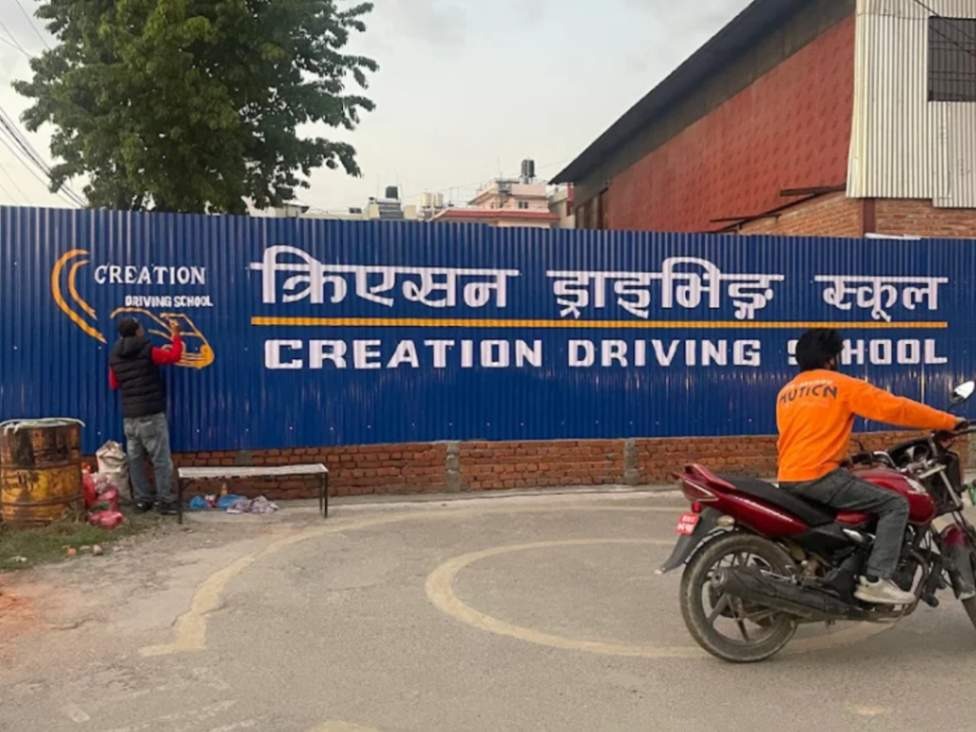
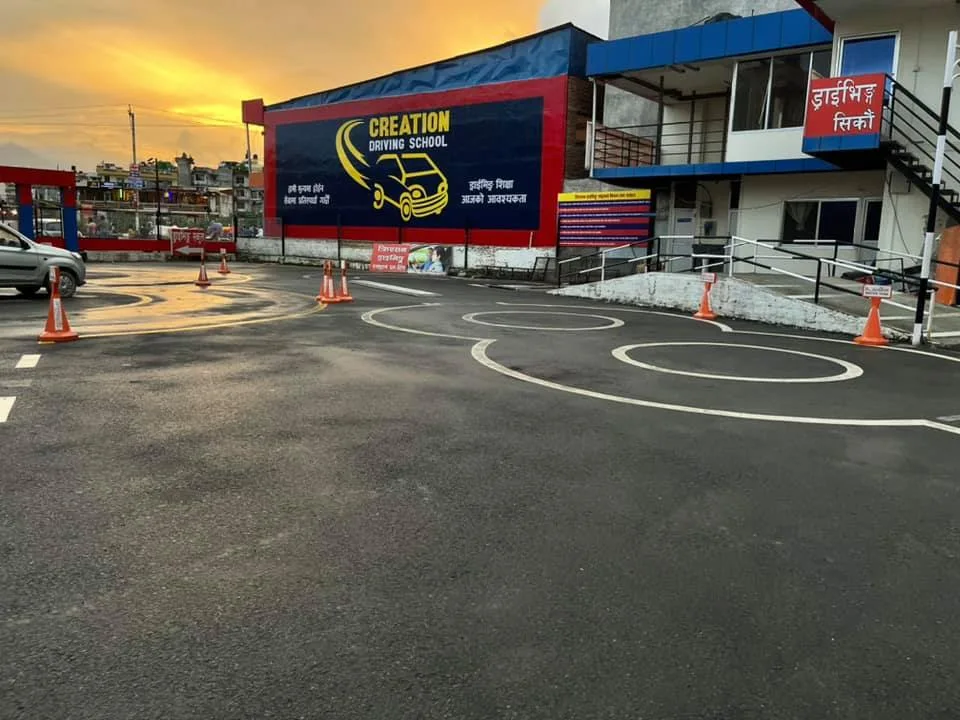
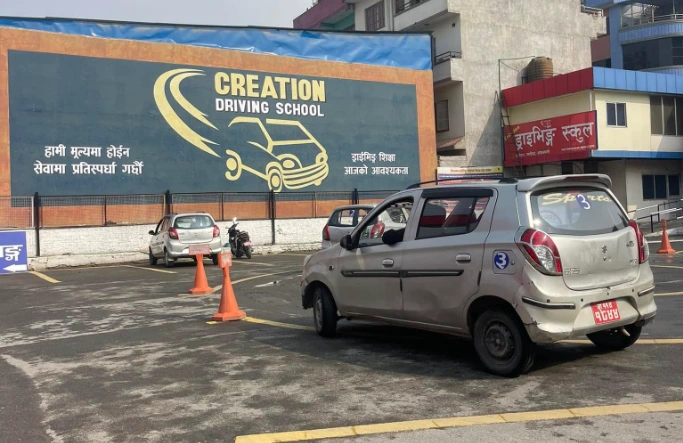
Driving Trial Practice on driving school

After you give the theory/likhit exam and have passed successfully, the last step you need to complete for obtaining the driving license smart card is to pass the trial test. The test ensures that you have the ability to operate a vehicle safely and are capable of driving on Kathmandu’s roads, where traffic congestion is common. Below is the step-by-step process of the driving license trial test. 

  • Step 1: Bring your documents, like the original Citizenship Certificate and your admitted card signed by you.
  • Step 2: Once your documents have been verified, you will be required to queue up for a very long time to wait for your chance for the trial.
  • Step 3: After your turn has come, go and take your trial vehicle, which is located in the parking area of the trial exam. After that, the examiner tells you to go to figure 8. You need to be calm and slowly drive the vehicle. The sections you have to complete for both 2-wheeler and 4-wheeler are given in Smart Tips to Crack Your Nepal Driving License Test on the First Try. 
  • Step 4: Once you have successfully completed the test, you need to park your vehicle and come to the staff to get your passing driving paper, which is then converted into a driving license. 

Do note that you must score 70 points out of 100 to pass the driving license trial test. To prepare for this test, you can go early and pay some fees according to the round before starting the trial exam.

Driving License Fees in 2026 

For obtaining a driving license, there are a series of steps you need to complete. To complete these steps, you need to pay fees. These fees must be paid during the application, written exam, and trial test processes. The following is the fees which you need to pay for the driving license:

  • You have to pay around Rs. 55 to Rs. 150 during the biometric and medical test.
  • The amount you have to pay for the written test is around Rs. 500 in the DOTM office.
  • You have to pay around Rs. 500 for the practical trial test for a motor cycle and also for the car/jeep.
  • You need to pay around Rs. 1,500 for a motorcycle/scooter, Rs. 2,000 for a car/jeep and for both categories, you need to pay around Rs. 2,200 for tax clearance . 

Conclusion

The driving license process in 2026 is a structured system that combines online application, written examination, practical trial tests, and fee payments to ensure proper evaluation of applicants. Each of the steps plays an important role in verifying the theoretical knowledge and practical driving ability of the applicant. To obtain the driving license, you should have documents such as an original citizenship certificate, an application slip, a valid blood group type and passport-sized photos. After having these documents, you fill out the form using a stepwise process, and complete the written and trial examination by following the process. During this process, certain fees need to be spent around 2,650 and other hidden costs for bike/scooter and 3,150 for car/jeep. After waiting for a few days to weeks, you receive your driving smart license. 

In this blog, we provided information regarding categories of driving licenses, eligibility requirements, documents required, and a stepwise process for the online driving license form. Along with it, we also gave insights about the written examination process, driving trial test process and driving license fee structure. For further information regarding driving licenses, do check out some other blogs. If you are seeking an ideal driving center in Kathmandu, contact Creation Driving – one of the best driving schools in Kathmandu

Related reads

Want to pass your Nepal driving license test on the first attempt? Explore our guide: How to Choose the Best Driving School in Kathmandu

FAQs on Driving License Process 2026

How long will the driving license process take in 2026? 

To complete the entire driving license process, it takes around 4 to 8 weeks in 2026. The entire process includes filling out the online form to card collection. 

Can I change my trial date after booking? 

You cannot change or reschedule your trial exam directly through the online system. If you want to change the date, you need to submit the formal written application in person to the office chief at the Transport Management Office. 

How can I check my application status? 

You can check your driving license application status by using your mobile phone or the internet. There are 3 methods through which you can check your application status. They are as follows: 
1. Online portal: Open the Online Driving License System and type your DOB (date of birth), license number and captcha. 
2. SMS Service: Go to the message app on your mobile and type LC [space] [your license number] and then send the 33001 or 31003.
3. Nagarik App: You can simply check whether your license has been printed or not by logging into the Nagrik App. 

Can I apply for multiple vehicle categories at once?

No, you cannot apply for multiple vehicle categories at once. The DOTM allows it one category at a time. 
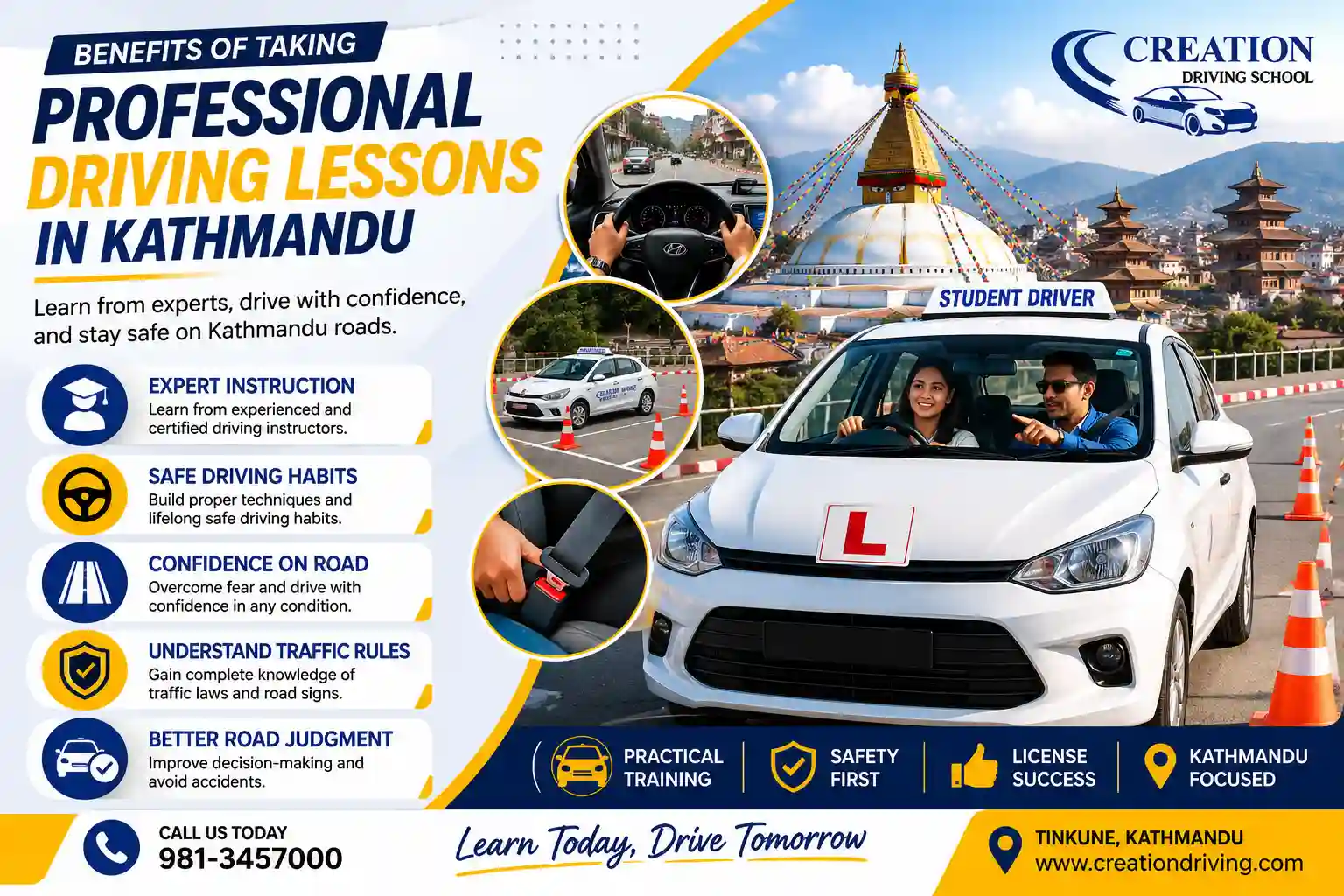
Benefits of Taking Professional Driving Lesson in Kathmandu 

Driving is a useful skill that provides you with the freedom of movement, ease of travel, and independence. If you reside in Kathmandu city, where traffic is heavy, roads are narrow and poor, then having sufficient knowledge about driving is very important for you. People may rely on friends and relatives to learn driving; yet, this process would result in their inadequate knowledge and improper driving practices. Thus, taking a professional driving class at a reputable driving school becomes necessary for everyone. The professional driving lesson includes a structured and practical approach to learning, which helps you to develop your skills and build confidence. With the help of trained instructors, real-road experience, and systematic training methods, quality driving schools in Kathmandu prepare you to handle real traffic situations while building long-term safe driving habits.

In this blog, we provide information regarding key challenges of driving in Kathmandu, the benefits of taking professional driving lessons in Kathmandu, and places to take a professional driving lesson in Kathmandu. 

Key Challenges of Driving in Kathmandu

Driving is one of the most convenient ways of traveling from one place to another. However, when you drive in Kathmandu, you may face several challenges. These include traffic congestion, narrow and poorly maintained roads, construction in roads, less availability of parking areas, and unpredictable driving styles. These challenges may make you stressful, tired and consume your time, especially during peak hours. Below are some of the key challenges you may face while driving in Kathmandu.

  • Heavy Traffic Congestion: In the morning, around office timing (between 7:00 a.m. to 9:00 a.m.) as well as in the evening time (around 4:00 p.m. to 6:30 p.m.), many cars and motorcycles start moving between their office and home, causing severe traffic jams, congestion, and long delays in reaching destinations.
  • Narrow and Poorly Road Conditions: In many parts of Kathmandu, you can find very narrow roads (only one vehicle can pass at a time). Moreover, countless potholes, uneven surfaces, and poorly maintained lanes exist in many places that affect your comfort and safety.
  • Limited Parking Spaces: Finding a wide parking space in the Kathmandu Valley is a major challenge. You may not find enough parking space on many streets, and proper parking facilities, leading you to spend extra time searching for a parking space where your vehicle can be parked. 
  • Frequent road construction: In Kathmandu, the government frequently constructs roads. They carry out road expansion, maintenance of roads and other utility work, which blocks the lane, diverts traffic, and creates sudden bottlenecks, which increase the travel time and confusion. 
  • Unpredictable driving behaviour: You may also find the unpredictable driving behavior of the driver while driving on roads. The drivers may suddenly change lanes, stop abruptly, or ignore lane markings, hampering your smooth movement and increasing the risk of accidents.

Due to the above reasons, taking a professional driving lesson is a must for all drivers in Kathmandu as it ensures safe and responsible driving. Taking driving training also helps in reducing the risk of accidents and improves overall road discipline in Kathmandu.

Benefits of Taking Professional Driving Lessons in Kathmandu 

There are several benefits of taking professional driving lessons in Kathmandu. By taking a driving lesson, you can easily understand and overcome the key challenges. It not only develops your driving skills, but it also helps in improving road awareness, traffic rule knowledge, and confidence while driving in busy conditions. Some of the benefits of taking professional driving lessons in Kathmandu are mentioned below: 

Learning Traffic Rules and Regulations Correctly

Professional driving lessons mainly focus on learning traffic rules and regulations correctly. Many drivers often learn the rules and regulations based on personal assumptions or from outdated information sources. This leads to violations and unsafe driving practices. Learning the traffic rules and regulations from the certified driving center with an experienced instructor helps you get the accurate and up-to-date information about traffic signs and signals, speed limits, lane discipline, parking regulations and legal responsibilities of drivers. These not only help you to pass the driving test, but also promote safer driving habits. 

Building Strong Driving Fundamentals 

One of the benefits of taking professional driving lessons in Kathmandu is to build a strong foundation of driving skills. The professional driving center teaches you regarding how to handle the vehicle with lessons on controlling the steering smoothly, using brakes, accelerating safely and managing clutch control). Moreover, they also focus on parking and maneuvering (parallel parking, reverse parking, U-turn, and tight-space maneuvering) and observation skills (checking mirrors regularly, monitoring blind spots, and anticipating potential hazards). These foundational skills help in forming safe and comfortable driving. 

Improved Road Safety

Professional driving lessons play an important role in improving road safety. This helps in avoiding any accident on the road, and also encourages safe and responsible driving. The driving instructor focuses on defensive driving techniques that help drivers anticipate and respond to potential dangers. They also train you in how to detect any dangers well in advance, maintain safe following distances, and avoid distractions. With the help of professional driving lessons, you become aware of reckless driving and blind intersections, reducing the accident risks and improving safety. 

Increased Confidence Behind the Wheel 

By taking professional driving lessons from experienced instructors, you can increase your confidence level. Many new drivers lack confidence when operating a vehicle on busy roads. As a result, they face accidents. To enhance the confidence of drivers, they must take a structured driving lesson, which helps them to develop better control of the vehicle. The experienced instructor provides proper guidance on steering control, braking techniques, clutch management, and safe driving practices in real traffic conditions, helping drivers to overcome the fear, reduce mistakes and build confidence. 

Better Preparation for Driving License Tests 

Obtaining a driving license is one of the major goals for those who are learning professional driving. With the help of professional driving skills, you can prepare for your exam more effectively. While learning to drive, you perform activities such as parking exercises, reverse driving, vehicle control, traffic observation and steering control which help you to prepare and pass the practical (trail) test easily. 

Long-Term Cost Savings 

Although at the initial phase, you need to spend some money to learn professional driving, but in the long run, it saves money by reducing accidents. Professional driving helps you provide knowledge of traffic laws, helping you avoid fines, penalties and other license-related issues. In addition, it also helps in reducing vehicle repair and maintenance costs by promoting safe and careful driving habits.

Where to take a professional driving lesson in Kathmandu?

Choosing the best driving center plays an important role in receiving professional driving lessons. You can find several driving schools that provide structured driving lessons in Kathmandu. One of the best and most reputable driving schools is Creation Driving School – one of the best driving schools in Kathmandu. Below are some of the reasons why you should choose this school for taking a professional driving lesson. 

  • Experienced and Professional Instructors: Creation Driving Center has highly experienced and professional instructors who give proper guidance on traffic rules and driving skills through a step-by-step procedure. 
  • Focus on Road Safety and Defensive Driving: This company emphasizes on road safety and provides defensive driving skills that are helpful in avoiding accidents, as well as practicing responsible driving on the roads.
  • Friendly and Motivating Learning Atmosphere: Creation Driving Center comprises friendly and motivational instructors that ensure stress free training and motivating atmosphere for their learners.
  • Good value for money: The company delivers exceptional training in driving at an affordable price and allows students to receive high quality practical experience without any financial burden.

Conclusion 

There are many advantages associated with professional driving lessons in Kathmandu for you. You get to learn basic driving skills, traffic laws and regulations, and how to drive in difficult situations. Professional driving lessons also ensure that you get to learn defensive driving skills, as well as ways to enhance road safety and responsible driving behaviors to reduce the likelihood of road accidents. This structured training also contributes in developing safe driving skills for drivers in the long run. Overall, investing in professional driving lessons is one of the smartest decisions that you make to ensure safety, confidence, and long-term driving competence.

In this blog, we provided information regarding key challenges of driving in Kathmandu, the benefits of taking professional driving lessons in Kathmandu, and places to take a professional driving lesson in Kathmandu. For further information regarding professional driving lessons, do check out some other blogs. Additionally, if you are seeking a driving center that provides professional driving lessons, contact Creation Driving Center – one of the leading driving schools and centers in Kathmandu

Related Reads

If you want to explore smart tips for passing the Nepal driving license test, read this complete guide.

For a complete guide to the driving license trial test in Nepal, check out this helpful resource.

FAQs on the Benefits of Taking Professional Driving Lessons in Kathmandu 

Will the professional driving lessons prepare me for the official Kathmandu trial test?

Yes, taking the professional driving lesson from Creation Driving Center helps you in preparing for the official Kathmandu trial test. They provide proper practical training, the latest information regarding traffic rules and guidance on all the skills required to pass the trial test.

How much do driving lessons typically cost at Creation Driving School?

At Creation Driving School, the cost for taking professional driving lessons based on packages and time is mentioned below: 

Based on the package

  • For Scooter and bike:
    • 7 days daily 30 minutes = Rs 4,000
    • 15 days daily 30 minutes = Rs 6,500
    • 20 days daily 30 minutes = Rs 8,000
    • 30 days daily 30 minutes = Rs 11,500
  • For cars:
    • 7 days daily 30 minutes = Rs 6,500
    • 15 days daily 30 minutes = Rs 12,000
    • 20 days daily 30 minutes = Rs 16,000
    • 30 days daily 30 minutes = Rs 22,000

Based on time

  • For the Scooter and the bike
    • 1 Hour(Own vehicle) = Rs 300
    • 1 Hour (Institute Vehicle) = Rs 600
  • For Car
    • 1 Hour(Own Vehicle) = Rs 600
    • 1 Hour(Institute Vehicle) = Rs 1600

Why do you need professional lessons when your family/friends can teach you?

You need professional lessons from a certified driving school, even though your family or friends can teach, because the driving school always provides structured, systematic training and a safe learning environment, which the family or friends may not offer and may sometimes pass on bad driving habits.

Can professional lessons help you navigate busy local roads? 

Yes, the professional driving lesson can easily help you navigate the busy local roads. During the driving lesson, the instructor provides practical guidance and teaches you how to handle real traffic situations safely and confidently.

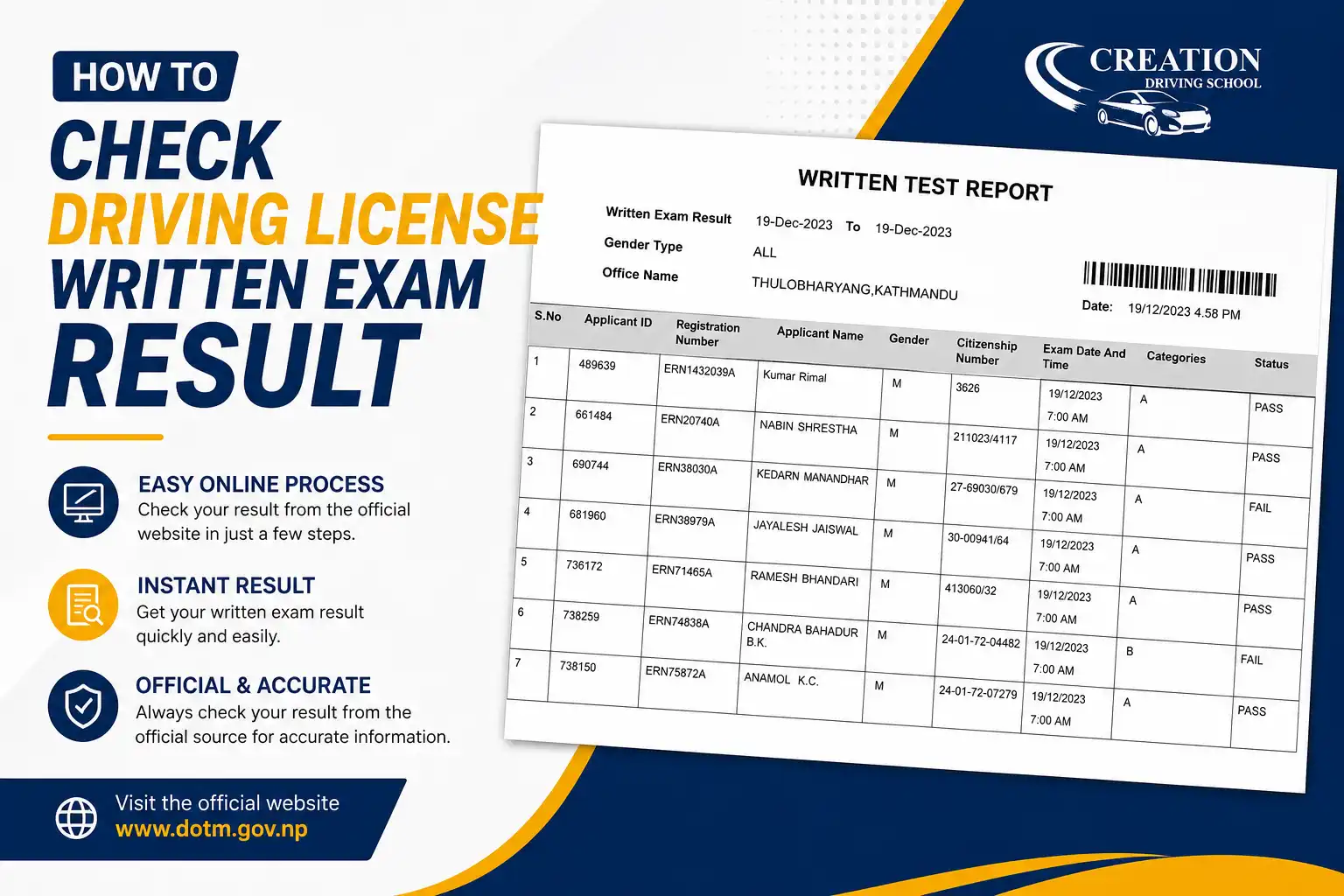
How to check driving license written exam result

Finding out about the result of the driving license written test is a vital component of the whole driving license application process. After you submit the application, complete the biometric registration and eye test and give the written test (Likhit Parikshya), you must verify the result to determine whether you have passed or not. To see the results, you must have details such as the Applicant ID number and the Date of Birth. These details enable the system to recognize the right candidate and show the result. You have three methods to view your result: online, via SMS, or by visiting the Transport Management Office for confirmation. This ensures that you can quickly know your status and proceed to the next step without delay.

In this blog, we provide the information regarding what you need before checking the written exam results, how to check driving license written exam results, a list of DOTM Facebook pages on the basis of location, and common problems when checking written test results.

Information You Need Before Checking Your Result

After you submit the application, complete the biometric registration and eye test by going to the dedicated Transport Management Office (Yatayat Byabastha Karyalaya), you need to give the written test (Likhit). This test ensures whether you know all the traffic signs, rules and regulations required for safe driving. Once you give the written test at the Transport Management Office, the next step is to check whether you have passed or not. To do so, there is some key information you need. These are as follows: 

  • Applicant ID number: It is an identification number given to each and every candidate who is applying for a driving license. This number helps in recognizing the application submitted by each candidate. This helps you in checking the result status.
  • Date of Birth (DOB): DOB and applicant number are used to verify your identity when checking results. While submitting the application, you must put your exact date of birth (DOB).

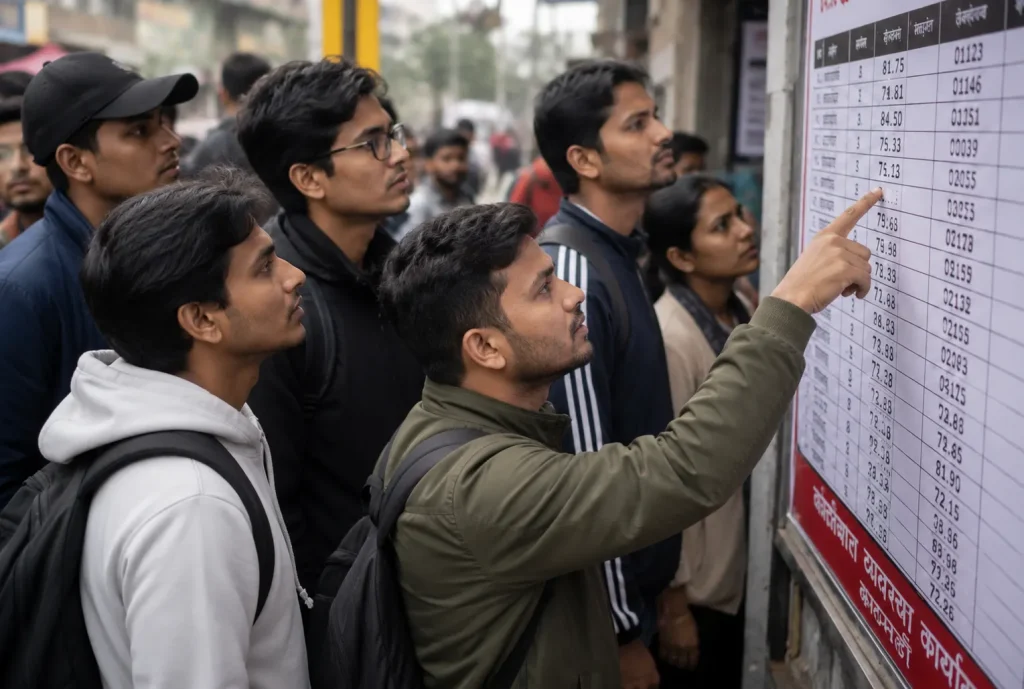
By having this information, you can easily check your theory test result when published, either online, through SMS or by visiting the Yatayat Byabastha Karyalaya to view the result that is posted on the notice board. 

How to Check driving license written exam result in Nepal

How to check driving license written exam result

The government of Nepal has provided various ways to check your written test (Likhit Parikshya) result in Nepal. This makes the process more convenient for applicants and allows them to access their results quickly and easily. If you are not aware of how to check driving license written exam results, you can check the Likhit Pariksha result through online, via SMS or by visiting the Transport Management Office (Yatayat Byabastha Karyalaya) where the results are displayed on the notice board. Below are the step-by-step instructions for each method you can use to check your written test result.

Check the Driving License Likhit exam results Online 

Checking the driving license exam result online is one of the fastest and most convenient ways. If you want to check driving license written exam results online, you need to follow the process which are given below: 

  • After knowing the written exam results have been published, you should immediately visit the official Facebook pages or websites of the respective transport office. 
  • Once you open the Facebook pages, you need to check their latest posts or use the search function to find the most recent exam result updates.
  • After that, you need to find your result by identifying the applicant number. 
  • You can also check the official website if available for immediate result access.

Check the Driving License result by SMS.

In case you don’t have the immediate availability of the internet, you can check the driving license likhit exam result by sending an SMS. The process for checking the results is listed below: 

  • Access your mobile messaging app.
  • Write WT [Application ID].
  • Deliver to 33001.
  • After sending it to the 33001, you receive your written test result. 

Check your driving license written exam result by going to the DoTM office.

For those who have an immediate problem accessing the internet, a direct visit to the Transport Management Office would be the most convenient option. You can see the Likhit results published on the notice board at the Transport Management Office. Through this, you can easily verify your result.

The Transport Management Office usually shows the written test results in the evening (4:00 PM and 6:00 PM) on the same day.

List of DOTM Facebook Pages by Location

The DOTM (Department of Transport Management) operates several official Facebook pages that are based in different locations. Such pages enable you to stay updated on any notices, results of the written examination, and other announcements from the Transport Management Office. The list of DOTM Facebook pages by location is mentioned below:

Common Problems When Checking Written Test Results

After you take the Likhit Pariksha at the Transport Management Office (TMO), you usually wait for the result, which is published in the evening of the same day. In the evening, when you try to check your driving license written test result, you may find a few problems. These problems may lead to delays, confusion, and frustration. Some of the common problems you may find when checking the theory test result are listed below: 

  • Website or System Not Working: You may find a website or system crash during the result time due to heavy traffic. Moreover, the pages may load very slow or may not open. 
  • Delayed Result Upload: Mostly, the results are published between 4:00 PM and 6:00 PM. However, sometimes the results may not be uploaded on time and cause further delays, which leads to confusion and uncertainty. 
  • Temporary Technical Maintenance: The government website may be down for maintenance at times during the period of the results. You may not be able to view the results for several hours or even days during this period. 
  • SMS Delivery Failures: By delivering the message in the wrong format for checking the written test, you may not receive the result and may get the invalid response. You should exactly type the WT [Application ID] and send it to the 33001 to see the results. 
  • Mismatch of Application ID: When checking the Likhit Pariksha result, you may forget your application ID, which stops you from accessing your result or leads to incorrect search attempts.

Conclusion

Checking the driving license written exam result is an important step to achieving the driving license. It plays a key role in determining whether you can proceed to the next stage of the licensing process or not. You can see the driving license written test through online, via SMS or by visiting the dedicated Transport Management Office. Depending on the method you use to view the results, you need information such as your Applicant ID number and date of birth. It is essential to enter the details correctly to avoid errors or delays while checking the results. You may face problems while checking the results, such as delay result upload, temporary maintenance, and the website or system not working. Therefore, you should stay patient and follow the correct procedure to access your results smoothly.

In this blog, we provided the information regarding the information you need before checking the written exam results, how to check driving license written exam result, a list of DOTM Facebook pages on the basis of location, and common problems when checking the written test results. For further information regarding the driving license written exam, do check out some other blogs. If you are seeking for a best driving school in Kathmandu that helps you pass the driving license written test on the very first try, contact Creation Driving Center – one of the best driving centers in Kathmandu. 

FAQs on how to check driving license written exam result

What to Do If You Fail the Written Exam?

Failing the written exam is normal. Many candidates fail the written test. If you fail in a first attempt, you don’t need to worry, as you can retake the exam by paying a re-examination fee of Rs. 400 per attempt. Do note that you must wait for at least 15 days before you retake the written exam. 

How long does it take to publish the result?

To publish the Likhit exam result, you must wait until the evening (between 4:00 PM and 6:00 PM) of the same day. You can see the result through online, via SMS or by visiting the Transport Management office in the evening. 

How long are the Likhit exam results valid?

In Nepal, the results of the Likhit exam are valid for up to 18 months (1 year and 6 months). Once the 18 months pass, you must restart the entire license application process from the very beginning. 

Can someone else check my result for me?

Yes, anyone can check the Likhit exam result as they are published publicly. To check the theory test result, you just need the Applicant ID and DOB (date of birth), depending on the method you use.

How to Choose the Best Driving School in Kathmandu

Taking a driving lesson is more than just learning to operate a vehicle, it is also about developing responsibility, awareness and confidence within you. For instance, in the congested city of Kathmandu  with difficult traffic conditions, having proper training for driving is essential in order to cope with the traffic situation and ensure road safety. A good driving school not only helps you to pass the license trial test but also teaches about road safety, traffic rules, vehicle control, and defensive driving techniques. To choose the best driving school in Kathmandu among other driving centers,  you need to look for a certified and patient instructor, understand the fee structure, and read the reviews and testimonials. 

In this blog, we provided information regarding why you should choose the best driving school in Kathmandu, how to choose, and common mistakes you should avoid while choosing the ideal driving school in Kathmandu.

Why should you choose the best driving school in Kathmandu?

There are several reasons why you should choose the best driving school in Kathmandu. Choosing the best driving school not only helps you build up confidence but also assists in being a responsible and skilled driver. In addition to that, it also makes your driving journey safe, smooth, and effective. Below are some of the key reasons regarding why you should choose the best driving school in Kathmandu. 

Learn Safe and Defensive Driving

At the best driving center in Kathmandu (Creation Driving School), you will be able to learn how to handle traffic safely, maintain lane discipline, avoid accidents, and react in emergencies with the help of experienced instructors. Moreover, the instructor also teaches you defensive driving techniques, helping you to reduce risky behavior on crowded Kathmandu roads. 

Certified and Experienced Instructors 

A registered driving school offers a certified and well-experienced instructor who provides proper guidance, professional training, and practical skills to all the students. Moreover, they also focus on individual learning needs, ensuring that each student builds up the confidence and skills required for safe driving.

Higher Chance of Passing the License Trial 

Taking the training from a certified driving center can increase the chances of passing the license test. Professional driving school helps you prepare thoroughly with proper practice, guidance, and test-based training. This helps you to gain confidence, hence increasing the possibility to pass the license trial on the first try. 

Road Safety Awareness 

The best driving center also prioritizes patience, discipline, and responsible driving behavior rather than only teaching how to operate a vehicle. Moreover, with the proper guidance and training from experienced instructors, it also helps in reducing panic, overconfidence, underconfidence, and reckless driving to prevent accidents. 

Structured Step-by-Step Learning System 

A professional driving school follows a structured learning system, helping you to gradually build their skills. This learning system advances from teaching the basic control (clutch, brake, gear) to advanced driving (highway merging, parking, reversing, hill driving), making learning smoother and less stressful. 

Modern Training Facilities 

Driving schools, such as Creation Driving Center, offer modern training facilities such as updated vehicles, a good training practice ground and structured training programs for cars, scooters and bikes. This allows you to pass the license trial test easily. 

How to choose the Best Driving School in Kathmandu? 

Choosing the best driving schools in Kathmandu is very important for every person wanting to learn the art of safe driving. Besides this, selecting the right driving school ensures that you gain adequate driving experience, knowledge of proper road awareness, and the ability to handle different traffic situations effectively. You can find several driving institutes around you, but selecting the right one ensures that you get the proper training, learning environment and experienced guidance that are required for passing the test. Below are the key points that you should consider before choosing the best driving school in Kathmandu.  

Look for Certified and Patient Instructors

While choosing the best driving school in Kathmandu, you should look for a certified and patient instructor. These instructors make the learning easier, especially for those who are at the beginner level. A patient instructor provides a calm, and supportive environment which helps every student to learn at their own pace and build confidence. 

Check How Long the School Has Been Operating

The next factor you need to consider is how long the chosen driving school has been operating. The older the driving school, the better training methods, proper guidance and professional support they can offer with the help of experienced staff. 

Check What Vehicles Are Available (Car, Bike, Scooter)

Before joining a driving center, you should also look for the type of vehicle you want to get a license for. Generally, most driving centers offer scooters, motorcycles/bikes and cars for training. However, there are some driving centers which offer training for heavy-vehicles such as buses and trucks. If you want to learn the skills of these vehicles, you can further the process. It is also equally important that you check the condition of a dedicated vehicle to ensure safety and a proper learning experience. 

Understand the Fee Structure — Transparent Pricing Matters

After checking the vehicle, you need to ask the driving center about the fee structure. Professional driving schools have transparency in their prices, and there are no hidden costs. The cost includes the lesson fees, registration costs and any extra costs for extra practice.

Ask About Class Timings and Flexibility

If the fee structure suits you, you should also ask about class timings and the flexibility they offer. You should choose the driving school that offers morning and evening classes, weekend options and flexible rescheduling, as it is very important, especially for students and workers. Choosing the school which offers these facilities makes it easier for you to manage driving classes as well as your personal life.

Check Road Safety and Traffic Rule Training

The best driving school not only focuses on improving driving skills, but also prioritizes teaching traffic rules, road signs, defensive driving, and safety awareness. Prioritizing these factors ensures that you become a responsible, confident and skilled driver.  

Read Real Student Reviews

Before finalizing which driving center to choose for training, checking the genuine student reviews and feedback is one of the most important things to do. The honest reviews help you know about the reality of driving. Moreover, it also gives insights into teaching quality, instructor behavior, success rate, and overall experience of the driving school.

Common Mistakes to Avoid When Choosing a Driving School 

As there are many driving centers in Kathmandu, people may make several mistakes while choosing. This can lead to poor training, wasted money, and difficulty in passing the driving test. In addition to that, it may also result in a lack of confidence and unsafe driving habits in the future. Some of the common mistakes that you should avoid while choosing a driving school are mentioned below: 

  • Choosing a driving school based on low price. 
  • Ignoring the experience and behavior of the instructors.
  • Without verifying whether the institution is certified or registered or not.
  • Not taking time to read the reviews and feedback.
  • Overlooking the condition of training vehicles.
  • Neglecting the flexibility of timings and schedule of classes.
  • With no knowledge about the training program structure.
  • Ignoring safety and road discipline training.
  • Rushing the decision to choose a driving school. 
  • Not checking vehicle condition. 
  • Choosing a school without comparing multiple options.
  • Not checking the school’s success rate in license trials.

Conclusion

Selecting the best driving school in Kathmandu is one of the important steps you should take to build strong driving skills and ensure long-term road safety. Choosing the appropriate driving center enables you to boost your confidence level and master driving techniques with proper guidance. It will also help you to pass the driving license test and deal with daily traffic scenarios responsibly. You can do so by analyzing some key factors, which include the instructor quality, training methods, vehicle condition, and student feedback. Overall, choosing the best driving school helps you become a disciplined and confident driver who can navigate Kathmandu’s busy roads safely and effectively.

In this blog, we provided information regarding why you should choose the best driving school in Kathmandu, how to choose, and common mistakes you should avoid while choosing the ideal driving school in Kathmandu. For further information regarding the best driving school in Kathmandu, do check out some other blogs. Additionally, if you are seeking the ideal driving institute in Kathmandu, contact Creation Driving School – one of the best driving centers in Kathmandu

FAQs on the Best Driving School in Kathmandu

1. How long does it take to complete driving training? 

Training duration for driving will depend upon the experience and confidence of the driver, along with the package chosen in the driving school. At the Creation Driving Center, the cost of driving training in Nepal as per their duration are listed below: 

For bike and scooter

  • 7 days daily 30 minutes = Rs 4,000
  • 15 days daily 30 minutes = Rs 6,500
  • 20 days daily 30 minutes = Rs 8,000
  • 30 days daily 30 minutes = Rs 11,500

For Car

  • 7 days daily 30 minutes = Rs 6,500
  • 15 days daily 30 minutes = Rs 12,000
  • 20 days daily 30 minutes = Rs 16,000
  • 30 days daily 30 minutes = Rs 22,000

2. Do driving schools help with license trial preparation? 

Yes, the professional driving school helps with the license trial preparation by providing trial-focused training, practical sessions, and proper guidance in each step. 

3. How can I know if a driving school is reliable? 

To know whether the chosen driving school is reliable or not, you should check online reviews, student feedback, years of operation, training facilities, and instructor qualifications. 

4. Can beginners join a driving school? 

Yes, the beginners can join the driving school freely. The experienced instructor provides step-by-step guidance from basic vehicle control to advanced driving techniques with confidence.

Driving License Trial Test in Nepal: What to Expect and How to Pass

The driving license trial test in Nepal is the final part of the whole licensing procedure. This test will measure your practical skill in driving such as controlling your vehicle, maintaining a balance, performing parking activities, and comprehending road safety guidelines. In the driving license trial test in Nepal, you are assessed with different tasks such as figure 8, slope handling, U-turns, and parking, depending on which you are applying for, either two-wheelers or four-wheelers. To pass these tasks, you should be calm, have control on the clutch, drive with slow speed, maintain mirror awareness, and mastery in figure 8 and ramp. 

In this blog, we provide information regarding what to expect on the driving license trial test in Nepal, what score do you need to score to pass the driving test, and where the points can be deducted. Along with this, we also give insights about how to pass the driving license trial test in Nepal, common reasons that candidates fail in the trial and why you should join the driving school.

What to expect on the Driving License Test in Nepal?

What to expect on the Driving License Test in Nepal

Before you begin your driving trial (Practical exam), you need to present the examiner with all of the required documents and pass the written driving test. There are various things you can expect on the driving license trail test in Nepal. These things include various driving tasks and evaluations that check your balance, control, and knowledge of road rules. Therefore, being aware of what to expect makes it easier to prepare yourself and pass the trials test for obtaining the driving license the first time. In this section, we will explain what to expect for both two-wheelers and four-wheelers.

Two-wheelers

  • Figure 8: It is the first phase of the trial. In this section, you should drive your two-wheeler vehicle within the shape of the letter ‘8’. This checks your balance, coordination skills, steering control and balance while driving.
  • Narrow plank: It is a thin and narrow plank that you need to drive. This checks the balance and skills required while driving in a straight line without any diversion.
  • U-turn: When you are at the point of the U-turn, you have to switch on the indicator before turning without hitting the boundary. The U-turn is needed to assess your ability to turn safely without losing balance or control.
  • Traffic lights/signals: The standard traffic lights are used during the trial. They are kept to check whether you understand and follow traffic rules correctly or not.
  • Speed breaker: On a trail location, you can find a speed breaker section. It is kept to test your ability to reduce speed and maintain control while passing uneven road surfaces.
  • Ramp/slope: It is an inclined surface which comes before completing the trail. It checks your control skills as you start, stop and hold the bike at an incline without rolling backwards.
  • Behavioral check: While performing the trial, the instructor observes your behavior. It is necessary for instructors to check your behavior regarding safety measures, indicator usage, and other good driving practices.

For four-wheelers

  • Figure 8: The four-wheeler vehicle you drive must go within the figure 8 without touching any boundary lines. This section checks your steering control skills and making correct turns, especially tight turns.
  • Speed breaker: It is a raised section on the track. This section checks your ability to reduce speed and maintain smooth control of the vehicle over bumps.
  • U-turn: On a trail location, you find a U-turn section where you need to turn your four-wheeler vehicle within a limited space. It is required to test your turning skills, spatial abilities and your safety practices while operating the vehicle.
  • Traffic lights: At one of the sections, standard traffic lights are kept in the test. This checks your understanding of road rules and ability to follow instructions correctly.
  • Ramp/slope: It is an inclined surface where the instructor tests your control of the vehicle when starting, stopping, or braking on an incline without moving forwards or stalling.
  • L-back (Reverse parking): It is considered as one of the hardest sections in the trail. This is a parking task where you need to reverse into an L-shaped space without touching any traffic cones. It tests your reverse driving skills as well as the proper use of a mirror for accurate parking.
  • Behavioral check: The instructor observes your behavioral traits in such a test. The skills to drive safely, following traffic rules and using signals and showing good discipline is mainly observed.

How much do I need to score to pass the driving license trail test in Nepal?

In early 2023, the government of Nepal introduced a point-based evaluation system through which the candidates were able to pass the practical exam (trial) more easily. Under this evaluation system, you should score at least 70 points out of 100 points to pass the driving license trail test in Nepal. In the trial exam, the examiner checks different driving tasks such as balance, vehicle control, turning, parking, slope handling, and adherence to traffic rules. Each of the tasks carries certain marks. If you make any mistakes, some points will be deducted, which reduces the chances of passing the driving license trail test. As per the current marking system, you can make minor mistakes but still pass the trial, making this process more flexible than the previous pass-or-fail-only system. However, making serious mistakes such as boundary line touching and losing control of the vehicle can lead to failure in the trial.

Where can points be deducted in the driving license trial test in Nepal?

As mentioned previously, the government introduced the point-based system in early 2023, and the candidates must bring 70 points out of 100 to pass the driving license trial test in Nepal. Therefore, many of you may not know where the points can be deducted while performing the trial. Losing the points consistently means there are higher possibilities of failing the trial test. Some of the sections where points can be deducted for both two-wheeler and four-wheeler are listed in a table format. 

Section Max pointsPoints DeductionTwo-wheelerFour-wheeler
Figure 8205 – 10 points5 points deducted for touching the boundary line once, and 5 points minus if you touch your feet to the ground once. 5 points will be deducted each time you touch the boundary line, up to two times. 
Narrow plank10Directly failDirectly fail if your feet touch the ground and are unable to cross the plank.Not applicable
U-turn1010 pointsLoses 10 points if you forget to turn on the indicator.Deduction of 10 points if you failed to activate the indicator.
Traffic lights/signals1515 pointsCut 15 marks if you fail to follow the traffic lights that are hanging. Lose 15 marks for not following traffic lights.
Speed breaker15 score for two-wheelers and 10 points for four-wheelers10 points for two-wheeler and 5 points for four-wheeler5 points reduction for touching the ground with your feet and 5 points cut if your two-wheeler engine turns off. Deduction of 5 points if your vehicle’s engine shuts off.
Ramp/slope20Directly failInstantly fail if you cross the boundary, engine turns off more than once and your vehicle slips more than 6 inches.Fail immediately if you breach the boundary, engine shuts off more than once, and your vehicle shifts more than 6 inches.
Parking (L-back)1510 pointsNot applicableThe points will be deducted if your vehicle touches the boundary. 
Behavior / Safety Check103 to 43 points cut if you didn’t check the brake, tyre and mirror, 4 score minus if you didn’t lock the helmet and 3 points reduction of you perform rough drivingDeduction of 4 points if you didn’t wear a seatbelt, 3 points cut if you didn’t check the mirrors, tyres and brakes and reduction of 3 points if you perform reckless driving throughout the trail. 

How to pass the Driving License Trial Test in Nepal with 100% score?

How to pass the Driving License Trial Test in Nepal with 100% score

Passing the driving license trial test in Nepal with a 100% score is difficult, but it can be achieved. By performing all tasks perfectly without making any mistakes or losing any points during the entire test, you can secure a full score. To avoid mistakes that can lead to losing points or failing the trial, there are different rules and instructions that you must follow. Some important tips to pass both the two-wheeler and four-wheeler driving license trial tests in Nepal are mentioned below:

For two-wheeler

  • Figure 8: Mastering the figure 8 leads to higher chances of passing the driving license trail test in Nepal. You should use a half clutch, keep the speed slow and maintain proper balance throughout the turn. 
  • Narrow plank: In the narrow plank section, you need to drive straight. In order to pass this section, you need to fix your eyes on the endpoint. Moreover, you shouldn’t look down at the wheel as it can cause loss of balance and increase the chances of failing the test.
  • U-turn: To turn your vehicle in the U-turn section, you should keep your vehicle speed low, turn on the indicator and steer smoothly while maintaining proper control of the vehicle. 
  • Traffic lights: Traffic lights are also one of the important sections of the trial. Before crossing the traffic light section, you need to see the colour that is shown in the traffic lights. If the light turns red, you need to stop for a while until it turns green. When the light is green, you can easily go, and if the light is yellow, you should slow down and prepare to stop.
  • Slope: It is one of the difficult sections of the trail. To pass the slope, you should slow your vehicle speed, control your clutch properly, press the brake and release it when the instructor tells you to move. 

By controlling the clutch smoothly, maintaining steady eyes and having zero panic movements, you can successfully pass the driving license trial test in Nepal. 

For four-wheeler

  • L-back (Parking): It is considered one of the hardest sections in the entire trail of four-wheelers. Mastering it can help to increase the chances of passing the driving license trail test in Nepal. You should move slowly in one gear, use clutch control for smooth entry, adjust steering in small movements and always align mirrors before entering is the key to completing the L-back section.
  • Ramp / Hill Start: This section is the hardest part of the trail. To complete this section, you must stop fully in line for a few seconds, hold the clutch at the bite point, add gentle accelerator for power, and release the clutch slowly when you move forward.  
  • U-turn: In the U-turn section, you need to slow down the speed of your vehicle, check mirrors, use indicators, turn wide and smooth and shouldn’t rush to rotate the steering to successfully complete this part. 
  • Traffic Signals: You should obey the traffic signals to avoid losing the 15 points. You should stay alert, stop when traffic lights turn red and yellow and move when the lights turn green. 
  • Figure 8: To successfully complete the figure 8 in four-wheeler vehicles such as cars, you should precisely control the steering, drive slowly and maintain proper clutch control throughout the section.

With the combination of clutch control, mirror discipline and slow precision driving, you can easily pass the driving license trial test in Nepal.

Common Reasons Candidates Fail the Trial

Many candidates fail the driving license trial test in Nepal, not because they lack driving skills, but because they feel overconfident/underconfident or make small mistakes that lead to failure. If you feel the same way, you should stay calm, practice regularly, and remain fully focused during the trial test. There are many other common reasons why the candidates fail the driving trial. Some of them include: 

  • Losing balance during the Figure 8 or narrow plank section. 
  • Putting a foot down frequently during the bike trial. 
  • Touching or crossing boundary lines and cones. 
  • Poor clutch control. 
  • Rolling backward on the ramp or slope section. 
  • Forgetting to use indicators before turning. 
  • Using the high gear during the trial.
  • Looking down instead of looking ahead while riding. 
  • Losing control during U-turns. 
  • Lack of confidence and nervousness. 

If you need further information regarding common mistakes that candidates often make that lead to failure, do check out the smart tips to crack your Nepal Driving License Test on the first try blog. 

Should You Join a Driving School? 

Passing the driving license trial test in Nepal requires joining a reliable and reputable driving school. Joining the trusted driving center helps you learn proper driving skills, understand traffic rules, and improve your chances of passing the trial test successfully. Among many driving centers, one of the best driving schools in Kathmandu is Creation Driving School. Some of the reasons why you should select the Creation Driving School are listed below:

  • Professional training: Our experienced instructor offers proper guidance regarding correct driving techniques, road safety and vehicle control.
  • Confidence building: We attempt to increase your level of confidence through repeated practice and proper guidance.
  • Secure and welcoming learning environment: We provide you with a safe and welcoming environment which will make it easy for you to learn.
  • Higher success rate: Most of the students who have taken driving training from us have successfully passed the driving license trial test with 100% score. 
  • Individual attention: Our instructor provides full attention to every individual who is taking the training from us, from the beginning to the end.  

Conclusion

The driving license trial test in Nepal may be challenging, but with the help of proper preparation, practice and choosing a reliable driving center, it can make it easier to pass. In order to pass the driving license trial test in Nepal, having driving skills is not enough; you should have discipline, patience, and careful attention to every detail of the trial.In addition to that, understanding the test structure, practicing difficult trial sections, and avoiding small mistakes like poor balance are also important. It is also equally crucial that staying calm and reducing nervousness during the test can greatly improve your performance and increase your chances of passing the driving test.

In this blog, we have provided information regarding what to expect on the driving license trial test in Nepal, how much score do you need to score to pass the driving test, and where the points can be deducted. Along with this, we have also given insights about how to pass the driving license trial test in Nepal, common reasons that candidates fail in the trial and why you should join the driving school. For further information regarding driving license trial tests in Nepal, check out some other blogs. If you are seeking a professional driving school in Kathmandu, contact Creation Driving School – one of the best driving centers in Kathmandu

FAQs on Driving License Trial Test in Nepal

If the trial examination is unsuccessful, when and how many times can candidates retake the exam?

If you are unable to pass your driving license trial test in Nepal on your first attempt, you can retake the exam up to two times. The trial must be done within the 90-day period from the date of your first failed attempt.

What is the hardest section of the Nepal driving trial?

The hardest section of the driving license trial test in Nepal is the ramp (uphill and downhill) for both two-wheelers and four-wheelers.It carries 20 points, and if you halt on the incorrect line or move backward, it can result in immediate disqualification. 

What is the cost to take the trial test and pay the license fee?

The cost to take a trial test is Rs 500 per attempt. Once you pass the trial successfully, the official license charge (revenue/rajaswa) is Rs. 1,500 for scooters/motorcycles and Rs. 2,000 for cars/jeeps.

Smart Tips to Crack Your Nepal Driving License Test on the First Try

Obtaining a driving license in Nepal is one of the necessary things in order to drive legally and safely on the road. However, many candidates find it difficult to clear both written (Likhit) and practical exams (trial) due to a lack of proper preparation and understanding of traffic rules. These exams are taken to check both your theoretical knowledge of road signs, traffic regulations, and your practical ability to handle a vehicle safely in real conditions. Many candidates fail to pass these exams because they underestimate its requirements or do not practice enough. Therefore, giving the mock test regularly, arriving at the center early, mastering the figure “8”, and staying calm can help you crack the Nepal driving license test on the first attempt successfully.

In this blog, we provide information regarding categories of driving licenses, eligibility, and documentation preparation for acquiring a Nepal driving license test, and tips to crack the written exam (Likhit). Along with this, we also give insights about tips to crack the practical test and common mistakes to avoid to pass the Nepal driving license test on the first try.

Categories of Driving Licenses in Nepal

In Nepal, the driving licenses are divided into several categories depending on the type and size of vehicle you drive. Whether it is a two-wheeler or 4 wheeler, each category requires a specific license type based on the engine size and vehicle class. These license categories can only be collected from the Transport Management Office (Yatayat Karyalaya) once you pass the practical test (trial). Below are the categories of driving licenses available in Nepal.

  • Category A: This Category is for motorcycles, scooters, and mopeds.
  • Category B: This category includes cars, vans, jeeps, and delivery vehicles up to 3,500kg.
  • Category K: This category applies to specific electric scooters, and low-powered mopeds.
  • Category C: Category C is for light trucks, tempos, and minibuses. 
  • Category D: This category applies to heavy trucks and buses. 
  • Category E: This category is for heavy equipment, and special vehicles such as cranes, road rollers and loaders.
  • Category H: This category applies to agricultural vehicles and tractors. 

Do note: For acquiring these licenses, your age must be at least 16 for two-wheelers, 18 for light four-wheelers, and 21 for medium/heavy vehicles.

Eligibility and Documentation Preparation for acquiring Nepal Driving License Test

Preparation for acquiring Nepal Driving License Test

To pass the Nepal driving license test, you should have mandatory documents and be eligible for the specific vehicle category. The question may arise, “What must be the eligible criteria and what documents are required for passing the Nepal driving license test?” Well, the eligible criteria and mandatory documents required are mentioned below: 

Eligible criteria

  • The candidate’s age should be at least 16 years old for scooters/motorcycles, 18 for jeeps/cars, and 21 for heavy vehicles.
  • He/she must be a Nepali citizen. 
  • The candidate should successfully complete physical and medical tests to confirm he/she has adequate vision, hearing, and no disqualifying physical or psychological conditions.

Required Documents

  • Download and print out your online application form produced from the official DoTM Online Portal.
  • An original Nepali citizenship certificate and a photocopy of it (both sides). 
  • A blood group card that states your blood group from a valid medical institution or certified health professional. 
  • Two to three current passport-sized photos. 
  • A sum of Rs. 10 post stamps to attach to your printed application form.
  • A printed vision certificate/eye test (for Category B and higher) and the original past driving license for adding a new vehicle category. 

Tips to crack the Written Exam (Theory Test) – In points 

For the written exam (Likhit), you first need to apply for the driving license online through the DoTM portal, fulfilling age and health requirements. After that, you need to submit the necessary documents (citizenship certificate, application form, and blood group card) to the specific Transport Management Office (Yatayat Byabastha Karyalaya) for the biometrics. Once you complete these steps, you are allowed to perform a written exam (Likhit). There are various tips you can follow to crack the driving license written exam. Some of the effective tips are listed below: 

  • Understand the exam format: Before giving a driving license exam, it is essential to understand the exam format. The exam contains 25 multiple-choice questions, each of the question carries 4 marks. To pass the written exam, you should get 60 marks (15 correct answers). The time limit for the theory exam is 30 minutes. You can take the exam in either English or Nepali.
  • Focus on traffic signs: Traffic signs are one of the easiest ways to score marks. You should focus on warning signs, mandatory signs, and guide signs properly to score the marks. It is essential to spend at least 15 minutes regularly to remember these signs. 
  • Give mock tests regularly: Giving mock tests helps quite a lot to secure good marks in written exams. A mock test helps you to identify your weak areas, improve time management, build confidence, and get familiar with the exam pattern. Mock tests provide practice with all possible types of questions that may come in the written exam (Likhit). 
  • Arrive Early at the center: It is advisable to come early at the center so that you remain calm and avoid any kind of last minute pressure. You should be at the center at least 30 minutes prior to the exam so that you can comfortably sit and answer all the questions accurately.
  • Read the questions and options carefully: After getting the questions, you need to carefully read each and every question as well as options, as many questions are tricky and have similar options. You need to be attentive to each word so that you can understand the question and choose the appropriate answer.

Tips to crack the Practical Test (Trial) 

Tips to crack the Practical Test

After passing the written exam, you are eligible to perform the practical test (trial). To crack the Nepal driving license test, you need to achieve at least 70 out of 100 points according to the existing point-based system. This test is designed to know your real driving ability, road safety awareness, and control over the vehicle in different situations. Some of the tips to crack the practical test (trial) are mentioned below: 

For two-wheelers

  • Master the figure (8): You need to practice driving the bike or scooter smoothly in an “8” track without touching your feet to the ground. It is important to maintain balance and control during the process of taking turns and driving through the “8” track. 
  • Traffic Lights and Indicators: During the trial, it is necessary to make sure that you use indicators during turning and drive according to traffic lights. Many candidates lose marks due to forgetting to use indicators while turning and not following traffic lights properly. 
  • Maintain Slow Speed: Throughout the trail, you need to slow the speed as much as possible. Riding the bike fast can reduce balance and increase mistakes during turns and narrow paths, resulting in failure. 
  • Stay Calm: You need to stay calm while performing a trial. A panic and nervousness often lead to bigger errors. Staying relaxed and focusing on control can help to pass the test. 
  • Manage Your Stability: Managing stability during the trial helps to pass the trial and achieve a license. You must learn how to apply brakes without making any sudden movements, which helps you maintain your stability.

You should also practice with various bikes, such as Hero Splendor, Yamaha Saluto, and Honda Pleasure (old as well as new ones), as these types of bikes are used to perform trail rides at the designated Transport Management Office.

For Four-Wheelers

  • Master the L-back: The L-back is considered one of the hardest parts of the trail. You need to practice reverse regularly with proper steering control and mirror observation. Following these tips to reverse the car without touching poles can lead to passing the trial. 
  • Uphill Control: Uphill control is also one of the difficult parts of the trail. It is essential to learn proper clutch, break and accelerator coordination while driving uphill. In addition, you should also prevent vehicles from rolling backward while stopping at an uphill slope. 
  • Follow rules: While giving a trial, it is essential to follow the rules accurately. You need to wear your seatbelt, adjust the mirror, and follow all the trail instructions carefully. Moreover, you also need to use indicators while turning. 
  • Clutch control: Smooth clutch control is essential in the trail. It is essential to avoid releasing the clutch quickly; it may stall the engine. You need to practice maintaining the balance between the clutch and accelerator.
  • Turning technique: In the trail, you find a section where you need to turn the 4-wheeler vehicle. You need to turn slowly and confidently. In addition, you need to use proper steering and lane positioning while turning. You shouldn’t cut corners too sharply or with excessive speed. 

If you want to learn to drive and are seeking to pass the Nepal Driving license test, the best place you can find to practice is Creation Driving, located at Madhyapur Thimi. This driving school, one of the best driving centers in Kathmandu, helps you to improve your driving skills through professional guidance, regular practice sessions, and trial-based training.

Common Mistakes to Avoid to Pass the Nepal Driving License Test on the First Try

Mistakes to Avoid to Pass the Nepal Driving License Test

There are several common mistakes that many candidates make while attempting the test. Such mistakes may seem minor, but they will cause you to lose marks or even fail the practical test. Therefore, it is important to be careful and avoid them during the trial. Some of the common mistakes that should be avoided to pass the Nepal Driving license test are listed below: 

  • Arriving at the exam center without proper preparation.
  • Ignoring traffic signs and basic road rules during study sessions.
  • Fast driving of the vehicle in the practical test. 
  • Feeling overconfident while conducting the trial. 
  • Taking risky steps during the trial. 
  • Feeling nervous during the whole trial period. 
  • Not following the instructions properly.

Conclusion

You can crack the Nepal driving license test in your first attempt by concentrating completely on preparing yourself and following a systematic approach. Knowing the traffic rules, learning about the road signs, and doing practice sessions for both Likhit and Trail will definitely increase your chances of success. Apart from that, avoiding mistakes like nervousness, lack of control over the vehicle, and failing to obey instructions will make sure that you crack the Nepal driving license test in your very first attempt. With patience, confidence, and proper preparation, you can crack both the written and trial tests easily and start your journey of driving in Nepal.

In this blog, we have provided the information regarding categories of driving license, eligibility, and documentation preparation for acquiring a Nepal driving license test, and tips to crack the written exam (Likhit). Along with this, we also provided insights about tips to crack the practical test and common mistakes to avoid to pass the Nepal driving license test on the first try. If you are seeking an ideal driving center in Kathmandu, contact Creation Driving – one of the best driving schools in Kathmandu

FAQs on Nepal driving license test

1. What is the age limit required to get a driving license?

As per Section 51 (a, b, c) of the Provincial Transport and Traffic Management Act, 2075, the age limit for a candidate to obtain a driving license is: 

1. For heavy vehicles: You must reach an age of 21 years.
2. For medium and small vehicles: Candidates must be 18 years or above.
3. For cars, jeeps, and two axled vehicles: You should be at least 16 years old.

2. Who is disqualified from receiving a driver’s license due to health reasons?

The candidates who are disqualified from receiving a driver’s license due to health reasons are listed below: 

1. If a candidate is unable to drive because of physical or mental disabilities.
2. Those with poor eyesight, even when wearing glasses. 
3. If a candidate suffers from color blindness, it makes it hard to tell red, green, and yellow apart.
4. Those who cannot perceive normal sound, signals and voices.
5. If a candidate has had their driving license revoked in accordance with Section 65.

3. What questions are asked in the driving license test in Nepal?

In the Nepal driving license test, there are various questions that are asked to the candidates. Some of the questions are listed below: 
1. Traffic Signs and Signals
2. Driving Knowledge and Safe Driving Practices
3. Vehicular Act and Regulation
4. Technical and Mechanical Knowledge
5. Accident Awareness

4. Can I take the theory test and practical test again after failing once?

Yes, you can definitely retake theory as well as practical tests. However, the rules will be different, depending on the specific test you did not pass and how many times you have attempted it. If you failed the written exam, you need to complete the form again, pay the fees, and take the test again. For the practical test, you are allowed to give the trial 3 times (2 retries) within a 90-day period.

Essential Road Safety Tips for All Old and New Drivers

Driving safely starts with awareness, patience, and steady practice. New drivers should always check mirrors before moving, maintain a safe following distance, follow speed limits, and avoid distractions while driving.

Good habits built during training make every journey safer. At Creation Driving School, our instructors focus on practical road awareness so learners understand how to handle real traffic conditions with confidence.

How to Prepare for Your Driving Test

Preparation for a driving test should begin with consistent practice. Learners should review traffic rules, understand road signs, practice parking, and become comfortable with clutch, brake, accelerator, and steering control.

Before the test day, get enough rest and arrive early. A calm mind helps you observe better and respond correctly during the test.

Why Professional Driving Lessons Matter

Professional driving lessons provide more than basic vehicle control. A trained instructor helps learners understand road discipline, defensive driving, traffic rules, and safe decision making.

Learning with structured guidance reduces bad habits and builds confidence faster. This makes professional training valuable for beginners as well as people who want to improve their driving skills.